


Road to prosperity A tunnel between Denmark and Germany is taking shape
Travelling by road or rail between Scandinavia and Hamburg has long meant either a detour through western Denmark or a 45-minute ferry between Rødbyhavn, on the Danish island of Lolland, and Puttgarden, on the German island of Fehmarn. An 18km road and rail tunnel under the Fehmarn Belt, the strait between the two, is meant to change that: once it opens, the crossing will take ten minutes by car and seven by train, and the rail journey between Copenhagen and Hamburg will be halved to two and a half hours.
Rather than being bored through the seabed, the tunnel is being assembled on it, from 89 concrete sections cast at a factory in Rødbyhavn and floated out one at a time. Femern, the state-owned Danish company building it, has put the cost at €7.4 billion, most of it paid by Denmark and €1.3 billion by the EU, to be repaid from tolls over some 40 years.
The fourth section was lowered into place at the end of September, putting nearly 900 metres of the tunnel on the seabed. When the rest will follow is less certain. The tunnel had been due to open in 2029; Sund & Bælt, the state-owned company behind the project, says it will recalculate the schedule and the budget once six sections are down, which it expects by the end of the year.
On Lolland, one of Denmark’s poorest areas, the question is what the tunnel will leave behind besides traffic. The government has designated a state industrial park at Rødbyhavn, and the council says it has held talks with 15 companies, from offshore wind to defence, about setting up there. Not everyone is convinced that will be enough: the head of a cross-border business organisation has pointed to the Channel Tunnel, whose endpoints at Dover and Calais remain places people pass through, and has called for a joint Danish-German growth plan. Building the tunnel may turn out to be the easy part.
This briefing was drafted by an AI agent and edited by a human before publishing. All information used in the article was vetted by a human prior to drafting.

Two small-scale Russian producers of liquefied natural gas located on the shores of the Baltic Sea have suspended supplies, ship-tracking data showed on Thursday as US sanctions kicked in.
Washington last month introduced new sanctions against Russia in response to its unprovoked attack on Ukraine, including against the Portovaya LNG and Kryogaz-Vysotsk plants, with a grace period until 27 February.
Kryogaz-Vysotsk, controlled by Novatek and Gazprombank, last dispatched a cargo on 18 February, with delivery to Belgium’s Zeebrugge terminal on 22 February, ship-tracking data show. The data also show that Portovaya LNG’s last cargo was delivered to customers in mid-January.
A tanker called Pearl, formerly known as Pskov, was last loaded with gas from Portovaya earlier this month and is anchored in the Gulf of Finland, along with the Velikiy Novgorod, a gas carrier that is also servicing the project.
Source: Reuters
Poland risks undermining efforts to revive fisheries in the Baltic Sea, Swedish representatives in the European Parliament have warned.
In a letter sent to the Polish government, the five Swedish MEPs who sit on the parliament’s fisheries committee have asked whether its aim of achieving a better balance between the interests of the fishing industry and environmental concerns will mean removing emergency measures to address past mismanagement of the Baltic Sea fisheries.
The measures were first implemented in 2019 and have been accompanied by drastically reduced quotas, in some cases closing fisheries entirely on the advice of biologists.
Poland currently holds the rotating presidency of the European Council, which sets the direction for the 27-member bloc. In an address to the fisheries council last month, the country’s fisheries minister said Poland was committed to sustainable fisheries practices, as well as protecting economic opportunities for fishermen.
Source: SR
Amid Swedish fears of Russian expansionism in the Baltic, local authorities in Ystad say they are preparing for a situation in which they receive refugees from Bornholm.
Ystad is a Swedish council, but it is the mainland port for the primary ferry serving the Danish island.
The Swedish military considers Bornholm, along with other Baltic islands, as targets of potential Russian attacks, and that has led Ystad council to include refugees from the island in its civil-defence planning.
Police on Bornholm are responsible for co-ordinating civil defence. In the event of an attack, they say their directions would come from Copenhagen, but Ystad officials have called for co-ordination at the council level with Bornholm.
Source: Ystad Allehanda / TV2/Bornholm
The number of overnight stays on Bornholm grew marginally in 2024, but more visitors outside of the summer season and an increase in the number of visitors from non-core markets suggests that the island’s second-largest industry may be poised for growth in the years to come.
End-of-year statistics published by Destination Bornholm, the island’s tourism board, show the number of overnight stays rose at an annual rate of 0.1% in 2024, to 1,691,257.
Denmark and Germany remained the two largest markets for Bornholm’s 4.1 billion kroner (€550 million) tourism industry. Though fewer Danes and Germans are visiting during the July-August high season, the decline has been somewhat made up by an increase in the number of visitors in shoulder seasons. The result is a tourism season that now spans from March to December.
Destination Bornholm highlighted significant—if small—increases in the numbers of visitors from emerging markets, including France, Italy, the UK and America, that it reckons could make up for the high-season decline.
Finnish and Swedish authorities are investigating a possible breach of the C-Lion 1 undersea cable linking Finland and Germany, Yle, a Finnish news outlet, reports.
The location of the break is reported to be near the island of Gotland in the Swedish economic zone, where a number of subsea cables have been damaged in recent months.
The cause of the break was not immediately known, and it may be due to the previous damage done the cable, a source told Yle.
The C-Lion 1 submarine cable, operated by Cinia, a Finland-based firm, was last damaged on Christmas Day. Finnish authorities believe that break was caused by the Eagle S, an oil tanker suspected of acting on Moscow’s orders. The same cable was also damaged last November.
Source: Yle
Danish manufacturers are at the ready to facilitate the rapid military buildup to the tune of 50bn kroner (€6.7bn) over the next two years announced by the prime minister on Wednesday. But they warn that any return to a military-industrial complex needed to sustain the military for the long-term will require more than just money.
“We should use this an opportunity to think strategically and truly modernise our society,” Lars Sandahl Sørensen, the managing director of DI, a business lobby, said. “Lawmakers won’t be able to avoid making considerable reforms, improving efficiency and investing in new technology and competitiveness.”
The additional funding comes on top of a 10-year, 190bn kroner plan to revamp the military, bringing it in line with Washington’s increasing demands that Nato members spend more on defence.
Denmark currently spends 2.4% percent of its gross domestic product on defence. That places it above the Nato target of 2%, but in January, Mette Frederiksen, the PM, told Danes to be prepared for cuts to some services, as her government looked towards spending 5% of GDP on defence in the coming years
Read more
The additional funding comes after years of cuts have hollowed out the military’s capabilities. And with Washington’s willingness to come to Europe’s aide in the event of a Russian attack now in doubt, Ms Frederiksen said the military would be allowed to fast-track purchases until it was rearmed, by-passing a lengthy and scandal-ridden tendering process.
Correction: We originally stated that the Nato spending target was 3%. Sorry.
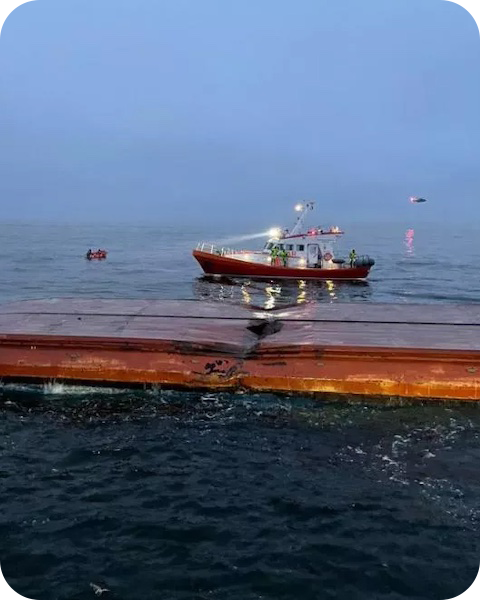
A court in Southampton, England, has sentenced the captain of a British cargo vessel and its operator for their roles in a December 2021 Baltic Sea collision that resulted in the deaths of two Danish seamen.
The crash occurred when the Scot Carrier, managed by Intrada Ships Management Ltd, collided with the Karin Høj, a Danish-registered barge, causing it to capsize. Investigators later determined that serious failures in watch-keeping and safety protocols contributed to the accident.
Sam Farrow, the 33-year-old master of the Scot Carrier, was sentenced on 14 Feb to eight months in prison, suspended for 12 months, for failing to prevent the collision, despite being aware that his second officer was unfit for duty. He was also ordered to pay £25,000 (€30,000) in legal costs.
Meanwhile, Intrada Ships Management Ltd was fined £180,000 and ordered to pay £500,000 in legal costs for failing to enforce safety measures that could have prevented the accident.
Read more
In 2022, a Danish court sentenced Mark Wilkinson, the second officer, to 18 months in prison after admitting to gross negligence and intoxication while on duty. Additionally, he received a 12-year ban from entering Denmark and had his maritime license revoked for operations in Danish waters.
(📸 Sjöräddningssällskapet)
The European Union is mulling a public-private initiative worth “hundreds of millions” of euros to buy ships that can promptly repair subsea cables in case of damage or sabotage, the bloc’s tech chief said.
“We are discussing now with member states what would be the amount that is needed,” Henna Virkkunen, the European Commission’s executive vice-president for technological sovereignty, security and democracy, said on the sidelines of the Munich Security Conference. “When it comes to security we see that there’s an urgent need for action.”
In recent months, there have been a string of incidents in the Baltic Sea in which telecommunication and power cables strung across the sea floor between countries were damaged by passing ships. While it is unclear whether these disruptions were accidental or intentional, they have spurred the EU to focus on its infrastructure’s resilience, including by ramping up the continent’s cable-repairing fleet.
Subsea cables carry internet and power connections across countries and continents and their loss can cause disruptions to digital services, including web access and payments, and force telecommunications providers to reroute traffic. More than 95% of global data traffic goes through subsea cables, according to the International Cable Protection Committee.
Source: Bloomberg
The Baltic states of Estonia, Latvia and Lithuania completed a switch from Russia’s electricity grid to the EU’s system on Sunday, severing Soviet-era ties amid heightened security after the suspected sabotage of several subsea cables and pipelines.
Ursula von der Leyen, the president of the European Commission, hailed the move, years in the planning, as marking a new era of freedom for the region, in a speech at a ceremony in Vilnius alongside the leaders of the three countries and the Polish president.
Debated for many years, the complex switch away from the grid of their former Soviet imperial overlord gained momentum following Moscow’s annexation of Crimea in 2014 and its invasion of Ukraine in 2022.
It is designed to integrate the three Baltic states more closely with the EU and to boost the region’s energy security.
Source: Reuters
Nato says it is ready to deploy artificial intelligence and uncrewed vessels in the Baltic as part of its increasing efforts to detect the telltale activity that could indicate that a ship is preparing to damage undersea cables and pipelines.
The military alliance’s hope is that it can use software to process information from satellite imagery, sonar systems and underwater sensors to spot merchant vessels that appear to be acting erratically above undersea infrastructure.
The software, known as Mainsail (a backronym for Multi-Domain Awareness and Insight with AI Layering), has been developed in response to concerns that Russia is engaged in a campaign of damaging undersea infrastructure in and around Europe.
The most dramatic of example of an attack on undersea infrastructure was the 2022 sabatoge of the Nord Stream gas pipeline. The evidence there points to Ukraine, but similar incidents in which Moscow is implicated were recorded before then; in recent months, the number has increased rapidly.
Read more
In November and December of 2024 alone, three separate cables carrying internet data and power between in the Baltic, connecting five Nato members—Estonia, Finland, Germany, Lithuania and Sweden—were severely damaged in incidents.
In most incidents, the damaging vessel—Russian or otherwise—cannot be identified, just as it is impossible to ascertain whether the damage was intentional. Both are often due to a lack of information. As a result, Nato has increased its presence in the Baltic Sea. It is hoped that, where they cannot deter future attacks, they can at least help to clear up which vessel is at fault.
As part of this effort, it is incorporating autonomous vessels that will be able to conduct persistent surveillance over large areas.
Labelled Task Force X, all members of the alliance were invited on to take part, but the hope is that Baltic Rim states will be among those to take the lead.
Nato says the countries taking contributing to the initiative are free to deploy their own assets, making it a proving ground of sorts that puts emerging technologies into active service.