


It will only get the region so far


An unrelenting push towards digitalisation claims is most recognisable victim. Other iconic offline institutions should take note

Move over Nordic film, here comes something even more unsettling

As is the case with most islands, there are two ways to get to and from Bornholm. The vast majority travel by sea: the ferry service transports some two million passengers annually, a service for which the current operator receives 4bn kroner (€540m) from the Danish state over the course of its 10-year contract. The locals complain a lot, but the operator turns a healthy profit.
Not so much luck on either count for DAT, the airline that offers the only other regularly scheduled way to get on or off the island. Its service, flying 200,000 passengers to and from Copenhagen each year, is neither subsidised nor profitable. Indeed, its current loss of 1.5m kroner per month had Jesper Rungholm, its managing director, earlier in the year publicly mulling whether to just stop serving the route from one day to the next, in breech of the airline’s contract with the local hospital to fly those patients who are too frail to take the ferry and the connecting coach service to Copenhagen for treatment.
Mr Rungholm immediately thought the better of doing so, telling the press the next day that his firm wasn’t the type to walk away from contracts. But his bellyaching served as a reminder that the route is not commercially viable, and that, unless someone in the government listens to his repeated requests to subsidise the route, his airline plans to stop serving Bornholm when the contact expires at the end of next November.
Read more
Mr Rungholm immediately thought the better of doing so, telling the press the next day that his firm wasn’t the type to walk away from contracts. But his bellyaching served as a reminder that the route is not commercially viable, and that, unless someone in the government listens to his repeated requests to subsidise the route, his airline plans to stop serving Bornholm when the contact expires at the end of next November.
What Mr Rungholm would like the government to do is to declare the Bornholm-Copenhagen route a PSO (short for public-service obligation). To date, Copenhagen as been unwilling to do so, on the argument that it would break EU rules—and, anyway, it says, it already spends 25m kroner annually running Bornholm’s airport, despite it too losing money, and that this constitutes a form of subsidy, albeit indirect.
Other airlines, primarily SAS and Norwegian, do occasionally fly to Bornholm, but typically only during times when there are lots of passengers, which only makes it harder for DAT to turn a profit and riles Mr Rungholm further.

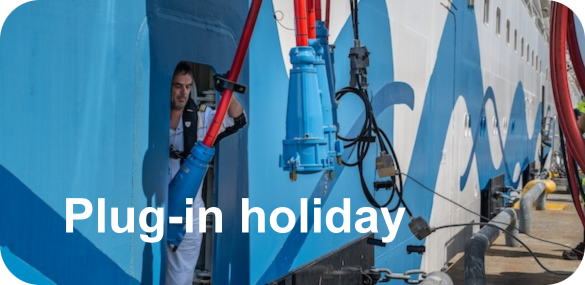
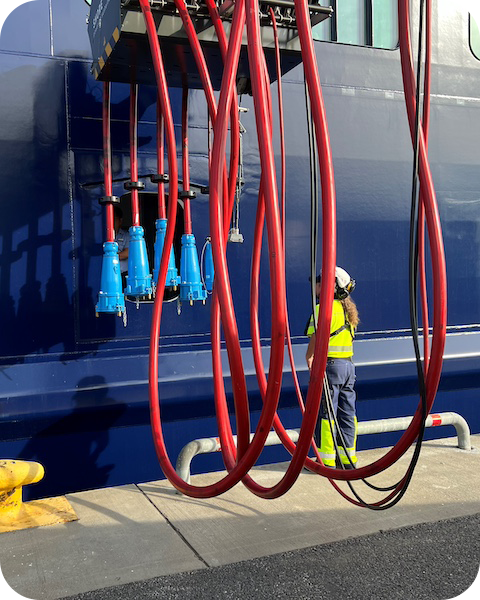
Shore-side power has become a major focus of the cruise industry’s efforts in recent years to reduce its environmental impact. It should come as no surprise, then, that Ports of Stockholm, the port authority overseeing the Swedish capital’s three main ports, made a big deal out it when it inaugurated the country’s on-shore power supply (or OPS) facility for international cruise ships on 17 September, making Stockholm the first port in Sweden—and one of just a handful in Europe—to allow cruise ships to power down their engines while in port.
Unlike a lot of other environmental initiatives, the benefits of on-shore power are immediately visible. For ships, being able to plug in, rather than run their engines, means no exhaust belching out of their smokestacks while in port.
This is because, in addition to propulsion, the diesel-electric engines that power most modern cruise ships also generate electricity. Often, more than half of an engine’s output is used for things like charging phones and keeping the lights on. Those are things that cannot be shut off entirely when the ships are in port.
Being able to plug in, more or less the way you would plug in an electric car, means less air pollution in the immediate vicinity of the ship, just as it also cuts out the noise the running engines generate. In places where the power is generated using renewable energy—such as Sweden’s hydroelectric or wind power—switching to on-shore electricity from on-board bunker brings down carbon pollution.
Read more
For now, about half of the cruise ships that land at one of Port of Stockholms’ ports can connect to electricity. This is more than double the amount that could a few years ago. By 2028, three quarters of the world’s cruise ships are expected to be able to plug in, according to CLIA, an industry group.
For cruise operators, there is an incentive in being a first mover, if it makes it possible to attract those who are turned off by the industry’s tarnished image. The promise of financial gain will undoubtedly speed the process along, but ports themselves can also play a role, either by directly mandating that ships be able plug in or by holding carrots.
Ports of Stockholm, for example, already offers discounts on port fees for ships that exceed emissions standards for carbon dioxide and soot. These could be extended to include on-shore power.
Paying ships to run cleaner makes more than just environmental logic, according to Jens Holm, the chair of the Ports of Stockholm board. It and three other Baltic Sea ports, Copenhagen/Malmö, Aarhus and Helsinki, all received funding from the EU to install OPS—amounting to 20% of the total €76mn the four port authorities will spend to do so—and he reckons this can help the Baltic Sea region market itself as a green cruise destination.
Mixing water and electricity may, in this case at least, not be such a bad idea after all.