


Posts Tagged ‘Finland’
Dual-use infrastructure Sweden and Finland are considering a bridge over the Gulf of Bothnia
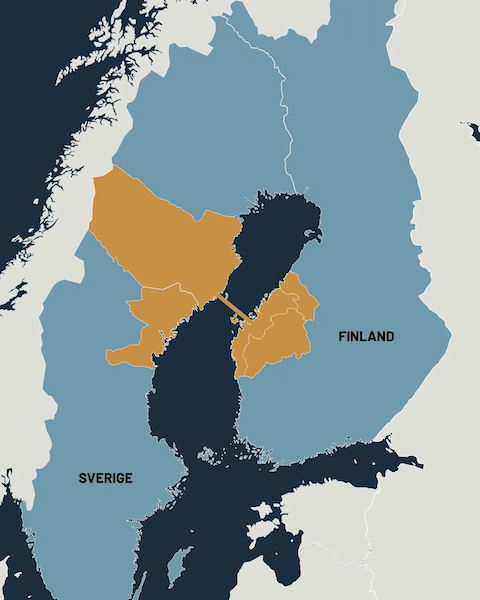
As far as building 100km bridges go, spanning the Kvarken, a narrowing of the northern Gulf of Bothnia, would be an easy task. Thanks to relatively shallow water, a generally firm seabed and an archipelago on the Finnish side, the challenge would lie less in getting the thing built than it would with coming up with the billions euros it would cost. (Estimates range from €5bn to €100bn.)
For that reason, when the idea has come up in the past, it has been easy for lawmakers in Sweden and in Finland to dismiss it as a costly white elephant that would have little benefit compared with the existing ferry service.
READ MORE
These days, though, the calculus that drives the cost-benefit analyses of such projects has a new variable: security. Where the idea of a better-connected region has long been framed in economic terms, a bridge across the Kvarken is increasingly being discussed as a way for Finns to remain connected to Europe in the event Russian shenanigans render the Finnish-Swedish land border unusable.
For now, a Kvarken bridge remains well over the horizon: a report published last year by Finland’s transport ministry reckons that the earliest one could be open for traffic would be the early 2040s. Still, proponents are bullish: the same report found a bridge was technically feasible and laid the foundation for an assessment of its economic benefits. A journey of a hundred kilometres begins with a single report.
FURTHER READING
} Fixed link across the Kvarken discussed in the Swedish Parliament (Kvarkenrådet)
} The €30-billion bid to link Finland to the wider EU (The Parliament)
} Finland wants to build a bridge across the Baltic Sea to Sweden for better connections to Europe (Euronews)
} Huge bridge between Sweden and Finland back on the drawing board (Ingeniøren)
} Kvarken Fixed Connection Feasibility Study (Väylävirasto)
Read MoreFFS2 project delivers solutions to decarbonise steel production
VTT has published its key results from the national Towards Fossil‑Free Steel (FFS2) project as part of the consortium final report. VTT’s work in FFS2 focused on solutions that help steel producers replace fossil fuels and make full use of industrial side streams in a future fossil‑free value chain.
The transition to fossil free steel requires not only new energy sources, but also system level solutions that work on an industrial scale. In the FFS2 project, VTT has addressed this challenge by developing and validating technologies that integrate electrification, hydrogen and circular material flows into existing and future steelmaking processes. The results strengthen the technological basis for industrial decision making and support a faster, lower risk transition towards fossil-free steel production
Read full announcement (external link)
Originally published on 7 Apr
Read MoreInsta to Modernize Cranes at Meyer Turku Shipyard

Insta is modernizing the overhead cranes in the production hall at the Meyer Turku shipyard as part of the shipyard’s extensive renewal program. The modernization of two 2 × 25 ton overhead cranes will improve crane usability and support the shipyard’s competitiveness.
Insta has signed a significant agreement with Meyer Turku shipyard covering the electrical modernization of two hall cranes. In the project, the technology of the two 2 × 25‑ton overhead cranes—largely in its original condition—will be upgraded to meet today’s requirements and production expectations. The modernization will enhance both the usability and operational reliability of the cranes.
Read full announcement (external link)
Originally published on 7 Apr
Read MoreFuture Expert Launchpad kicked off in Oulu – new application round now open
The Future Expert Launchpad (FELP), launched in Oulu, brings together professionals from different fields, companies, and best practices in innovation work. Over the course of eight weeks, participants develop solutions to real business challenges, receive guidance from experts, and discover new directions for their careers. FELP offers an opportunity to step into a creative and energetic environment where ideas grow into concepts.
The Future Expert Launchpad (FELP) kicked off in March in Oulu as a collaboration between BusinessOulu and Demola. This intensive eight‑week program offers current and future innovation professionals from various fields the opportunity to develop new product and service concepts and demos in teams. The goal is to support the employment and skills development of highly educated professionals, international talents, and jobseekers looking for a new direction in their careers.
Read full announcement (external link)
Originally published on 1 Apr
Read MoreReport: Finland’s Baltic Sea Fisheries at a Crossroads – societal cost or asset

A new report shows that Finland’s current large-scale trawl fishing in the Baltic Sea results in a socio-economic loss of nearly five million euros per year. This is at a time when several fish stocks are at dangerously low levels. Calculations also show that a new fisheries policy shifting focus from industrial trawling to primarily coastal fishing for food fish could generate socio-economic benefits of up to 25 million euros annually.
Finland’s herring catches in the Baltic Sea have fallen significantly since the peak year of 2016. Despite catches falling by nearly 60 per cent, several fish stocks are at critically low levels. Previously valuable and prized food fish such as Baltic cod and salmon have declined dramatically and can no longer be fished due to fishing bans.
Read full announcement (external link)
Originally published on 30 Mar
Read MoreMetsä Group to build a commercial CO₂ capture plant in Rauma

Metsä Group has launched a preliminary planning project for the first commercial biogenic carbon dioxide capture plant. As part of the plant’s financing plan, the company has submitted an application to a reverse auction organised by the Ministry of Economic Affairs and Employment, which awards investment grants to clean transition projects.
The potential facility would be located adjacent to Metsä Group’s Rauma pulp mill, and its nominal capacity would be approximately 100,000 tons of captured wood-based carbon dioxide per year. The carbon dioxide would be captured from the mill’s flue gases. This would be a commercial production facility, and its planned capacity would be the first step toward a larger scale: at Metsä Group, the long-term carbon dioxide capture potential from wood is several million tons per year. Carbon dioxide can be used as a raw material in the chemical and fuel industries, among others, and can replace the use of fossil raw materials.
Read full announcement (external link)
Originally published on 31 Mar
Read MoreSitra makes recommendations for the EU Circular Economy Act

Dependence on imported raw materials has made Europe vulnerable, exposed to supply chain disruptions and geopolitical uncertainty. Smart regulation is needed to create a level playing field for circular materials, products and business models, and to encourage innovation and reduce environmental pressures.
The European Union is currently formulating the Circular Economy Act (CEA) as a decisive step towards a competitive and more sustainable Europe. This presents a critical opportunity to move Europe’s circular economy from ambition to delivery.
Read full announcement (external link)
Originally published on 31 Mar
Read MoreFinnish officials visit Hycamite, highlighting its rising critical minerals role
A delegation of Ministry of Foreign Affairs officials, along with other distinguished guests, visited Hycamite Friday for a tour of its Customer Sample Facility (Decarbonization Plant). The group explored the company’s technology and capabilities, including its battery‑grade graphite production capabilities.
CEO Laura Rahikka and Chairman of the Board Matti Malkamäki hosted the visitors. Following the tour, Malkamäki provided an in-depth briefing on Hycamite’s methane-splitting technology, its role in electrification, and our capacity to convert carbon into battery-grade graphite. Hycamite’s industrial-scale demonstration plant capacity produces 2 kt hydrogen annually in addition to high-value, solid carbon products.
Read full announcement (external link)
Originally published on 30 Mar
Read MorePoland’s and Finland’s hydrogen clusters forge alliance to boost Baltic energy independence
In a significant move to bolster European energy independence, Hydrogen Cluster Finland and Poland’s key Hydrogen Cluster Lower Silesian Hydrogen Valley Association (LSHVA) today signed a Memorandum of Understanding to accelerate the creation of an integrated hydrogen market in the Baltic Sea region. The Memorandum of Understanding was signed at the leading Polish hydrogen conference, H2 Poland, taking place in Poznań.
The parties agree to cooperate in advancing a sustainable and safe green and low carbon hydrogen economy through knowledge exchange, ecosystem building, and mutual promotion of innovation and industry development. In addition to its regional role in one of the key hydrogen hubs of Poland, LSHVA will serve as national coordination platform for Finnish-Polish hydrogen interests.
Read full announcement (external link)
Originally published on 25 Mar
Read MoreFinland needs a growth agreement – Sitra publishes an unprecedentedly comprehensive review of the building blocks of sustainable growth
The problems affecting the Finnish economy are deep and structural. Sitra proposes a solution in the form of a growth agreement that transcends government terms and party lines.
“Finland has all the necessary prerequisites to overcome its current underperformance. We have world-class technological expertise, strong societal trust that supports growth, and well-functioning institutions. From this starting point, we must aim higher,” says Sitra’s President Atte Jääskeläinen.
Read full announcement (external link)
Originally published on 25 Mar
Read More