


Posts Tagged ‘Sweden’
Dual-use infrastructure Sweden and Finland are considering a bridge over the Gulf of Bothnia
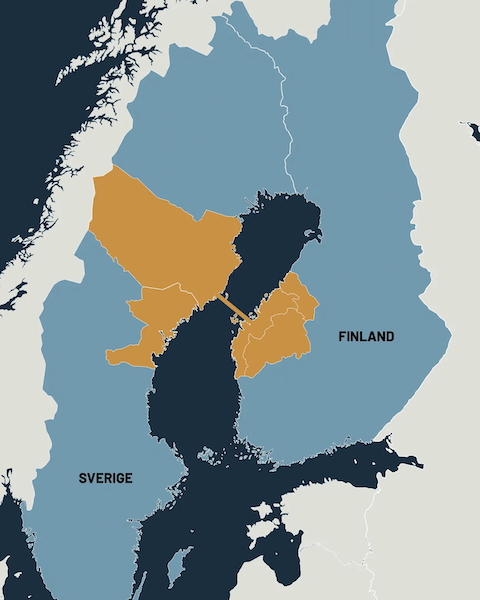
As far as building 100km bridges go, spanning the Kvarken, a narrowing of the northern Gulf of Bothnia, would be an easy task. Thanks to relatively shallow water, a generally firm seabed and an archipelago on the Finnish side, the challenge would lie less in getting the thing built than it would with coming up with the billions euros it would cost. (Estimates range from €5bn to €100bn.)
For that reason, when the idea has come up in the past, it has been easy for lawmakers in Sweden and in Finland to dismiss it as a costly white elephant that would have little benefit compared with the existing ferry service.
READ MORE
These days, though, the calculus that drives the cost-benefit analyses of such projects has a new variable: security. Where the idea of a better-connected region has long been framed in economic terms, a bridge across the Kvarken is increasingly being discussed as a way for Finns to remain connected to Europe in the event Russian shenanigans render the Finnish-Swedish land border unusable.
For now, a Kvarken bridge remains well over the horizon: a report published last year by Finland’s transport ministry reckons that the earliest one could be open for traffic would be the early 2040s. Still, proponents are bullish: the same report found a bridge was technically feasible and laid the foundation for an assessment of its economic benefits. A journey of a hundred kilometres begins with a single report.
FURTHER READING
} Fixed link across the Kvarken discussed in the Swedish Parliament (Kvarkenrådet)
} The €30-billion bid to link Finland to the wider EU (The Parliament)
} Finland wants to build a bridge across the Baltic Sea to Sweden for better connections to Europe (Euronews)
} Huge bridge between Sweden and Finland back on the drawing board (Ingeniøren)
} Kvarken Fixed Connection Feasibility Study (Väylävirasto)
Read MoreSaab receives order for counter-unmanned aerial system from Sweden

Saab has received an order from the Swedish Defence Materiel Administration (FMV) for a mobile and modular counter-unmanned aerial system (C-UAS). The system is designed to protect the Swedish Armed Forces as well as civil infrastructure from threats posed by drones. The order value is approximately SEK 2.6 billion and deliveries will take place 2027-2028.
In partnership with the Swedish Armed Forces and FMV, Saab is developing and deploying an advanced C-UAS system that offers proven, adaptable and cost-efficient layered defence against modern drone threats. The system will strengthen and complement Sweden’s current air defence and drone defence posture.
Read full announcement (external link)
Originally published on 2 Apr
Read MoreBAE Systems awarded $180m contract for Tridon Mk2 from Sweden

The TRIDON Mk2 is a truck-mounted 40 mm anti-aircraft gun system that addresses a gap in today’s air defense. The system has multi-target capability and can engage a wide range of aerial threats, including drones, cruise missiles and aircraft. Additionally, it can target ground threats such as armored vehicles, providing protection and security for both military forces and civil infrastructure.
“We are more committed than ever to providing our customers with protection from ever-evolving aerial threats,” said Lena Gillström, president of BAE Systems Bofors. “The TRIDON Mk2 has been designed for today’s warfare, and we will continue to deliver cutting-edge solutions to put our customers in the best position to meet future challenges.”
Read full announcement (external link)
Originally published on 2 Apr
Read MoreIf at first you succeed Sweden cuts VAT on food
A temporary reduction in the value-added tax on food items takes effect in Sweden today. As part of an 80 billion kronor (€7.35 billion) package passed in September aimed at supporting households and the economy, particularly in response to rising food prices and inflation, Swedes will pay 6% on retail food items until the end of 2027. (To the ire of restaurateurs, the VAT on prepared foods eaten on premises will remain at 12%.)
For the average family, the savings are expected to add up to 6,500 kronor (€594) per year, and the hope among the lawmakers who agreed on the reduction is that voters will remember where the money came from when they go to the polls later this year. But with an annual median income in the neighbourhood of 400,000 kronor, Swedes will be more concerned that the reduction will be paid for by reduced spending on other programmes.
READ MORE
Rising fuel prices stemming from the closing of the Strait of Hormuz also threaten eat up any savings at the supermarket. But there is a tax cut for that too: starting on 1 May, the government will reduce fuel duties to the EU minimum, in effect, extending until September a reduction that has been in place since 2022.
Note: This article originally incorrectly stated that all prepared foods will continue be assessed a 12% VAT. Sorry.
FURTHER READING
} Sweden to temporarily halve food VAT in election-year budget (Reuters)
} Sweden: VAT for food is lowered (Nordea)
} Sweden’s gasoline tax cuts make driving cheaper — but at what cost? (Stockholm School of Economics)
} Sweden’s government to cut taxes on petrol and diesel (Svergies Radio)
Sweden: EIB loan to help Stockholm cut wastewater pollution and protect the Baltic Sea
The European Investment Bank (EIB) is lending the City of Stockholm 5 billion Swedish kronor (around €470 million euro) to finance the city’s largest environmental investment in decades. The project involves closing the Bromma treatment plant and routing all the city’s wastewater to a significantly expanded and modernised treatment plant at Henriksdal.
The key element of the investment is a new wastewater collection tunnel that will transport sewage from Bromma to Henriksdal. The plant there will be expanded using advanced membrane technology, making it possible to treat more water without increasing the floor area and with significantly better results.
Read full announcement (external link)
Originally published on 26 Mar
Read MoreUnleash the lawyers Armed with regulations, coast guards are getting tough on the shadow fleet
Moscow has resumed shipments of crude oil from two Baltic Sea ports near St Petersburg after a drone attack damaged a loading facility at Primorsk on Sunday. A second facility, at Ust-Luga, was closed as a precaution but re-opened after authorities lifted an attack alert. The two ports are major outlets for Russian oil, and the attack was a part of Ukraine’s strategy of targeting oil refineries in order to disrupt Moscow’s war economy.
Countries of the Baltic Sea region would like to see traffic to and from Primorsk and Ust-Luga stopped as well—for the added reason that the 1,000 or so ships that Russia uses to transport the oil and other banned items are not seaworthy, and they fear they will cause an accident. They are also suspected of being used by Moscow to sabotage undersea infrastructure.
READ MORE
But where Ukraine has the option of sending drones to accomplish its goals, Baltic Sea countries have had to tread more carefully for fear of provoking the Kremlin. That meant only stepping in when vessels posed an imminent danger, or when they were suspected of causing damage.
Now, though, their coast guards are becoming increasingly proactive. The Swedish coast guard, for example, boarded two vessels in a single week earlier this month. In one of the incidents, the captain was detained for “violating maritime code and the ship safety act, as well as the use of a forged document”. Those are hardly fighting words—but that is precisely the point.
Sweden: EIB launches first pre-IPO support to help European growth company access public markets
The European Investment Bank (EIB) has signed its first pre-IPO advisory agreement to help a European growth company prepare for access to public capital markets. The support is provided through the InvestEU Advisory Hub and aims to strengthen the ability of innovative European companies to grow and remain in Europe as they scale.
The agreement supports Swedish biotechnology company Anocca, based in Södertälje, which develops next-generation T-cell immunotherapies for cancer. T-cell immunotherapy is a form of treatment that uses a patient’s own immune cells, engineered to recognise and attack cancer cells more effectively.
Read full announcement (external link)
Originally published on 18 Mar
Read MoreSwedish Government funding brings the Malmö CO₂ Hub closer to realisation

The development of a CO₂ hub in Malmö has taken an important step forward. The Swedish Energy Agency has granted 31 million SEK to Nordion Energi through the national Industriklivet programme to complete the analytical work required ahead of a final investment decision in 2027.
The funding supports the joint ambition to establish an open-source hub for CO₂ capture, transport and storage for all interested emitters in the region — a project in which Copenhagen Malmö Port (CMP) is a key partner – and where the port in Malmö has been identified as the optimal hub location.
Read full announcement (external link)
Originally published on 12 Mar
Read MoreSaab signs new agreements with Polish PGZ and WB Group
Saab deepens its collaboration with Poland’s defence industry and has today signed further collaboration agreements with Polska Grupa Zbrojeniowa (PGZ) and WB Group.
“Signing these new agreements with both PGZ Group and WB Group marks important new milestones in strengthening collaboration between the Polish and Swedish defence industries. By sharing expertise and scaling up innovation together, we can ensure the development of advanced solutions and capabilities that will contribute to security and stability in Europe and the Baltic Sea region,” says Micael Johansson, President and CEO of Saab.
Read full announcement (external link)
Originally published on 12 Mar
Read MoreArms across the water Sweden is helping Poland spend its defence budget
A delegation of more than 100 representatives from Sweden, led by the country’s king, wrapped up a three-day visit to Poland on Wednesday that was focused on deepening security and economic co-operation between the two countries.
The visit comes as Stockholm and Warsaw are assembling defence forces that Moscow would think twice about tangling with. Both have shown that they can keep low-intensity harassment in the Baltic in check, but the bigger concern is whether they would be able to prevent a Russian land grab, and whether they could do so independent of American help.
READ MORE
A Polish-Swedish partnership is a match made in military-industrial heaven. Concerned that it does not have the modern kit needed to pose a credible deterrence, Poland is spending half of its defence budget—per capita the largest in Nato—on new equipment. That is more money than it can spend at home, and it has made Poland one of the biggest markets for Swedish arms exporters.
Saab’s sales of big-ticket items account for much of that, but there is plenty of potential for smaller firms to get in on the act, according to Business Sweden, a lobby group. It reckons that there are some 380 companies—many of them small and medium-sized—involved directly in arms production, and that vastly more making the civilian technologies that go into weapons. Modern warfare is good business for ploughshares that can be used as swords.