


Bornholm’s off-season tourism growth offsets summer decline
The number of overnight stays on Bornholm grew marginally in 2024, but more visitors outside of the summer season and an increase in the number of visitors from non-core markets suggests that the island’s second-largest industry may be poised for growth in the years to come.
End-of-year statistics published by Destination Bornholm, the island’s tourism board, show the number of overnight stays rose at an annual rate of 0.1% in 2024, to 1,691,257.
Denmark and Germany remained the two largest markets for Bornholm’s 4.1 billion kroner (€550 million) tourism industry. Though fewer Danes and Germans are visiting during the July-August high season, the decline has been somewhat made up by an increase in the number of visitors in shoulder seasons. The result is a tourism season that now spans from March to December.
Destination Bornholm highlighted significant—if small—increases in the numbers of visitors from emerging markets, including France, Italy, the UK and America, that it reckons could make up for the high-season decline.

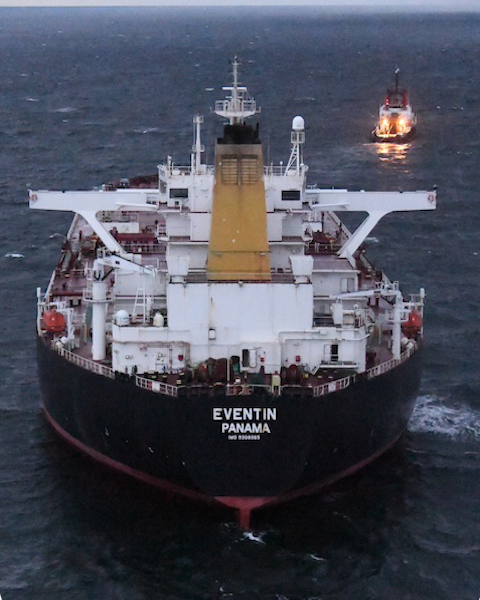
German customs authorities have confiscated the Eventin, a tanker linked to the Kremlin’s “shadow fleet”, along with its cargo of approximately 100,000 tons of crude oil. The ship was impounded in January and its seizure comes after the EU placed it on its sanctions list.
The seizure is a notable escalation in the enforcement of sanctions against Moscow’s attempts to get around restrictions on its oil trade. The “shadow fleet” of vessels flying flags other than the Russian is used to transport oil. It emerged shortly after Moscow’s unprovoked 2022 attack on Ukraine in response to Western sanctions against the Russian oil industry.
Recently the fleet’s role in wreaking havoc on subsea infrastructure has been getting a lot of attention. Environmentalists, for their part, fret that the ships are an oil spill waiting to happen; they are old, poorly kept and lack proper insurance. The Eventin was found floating adrift in January off the island of Rügen.
Germany’s seizure sends a message to Moscow and its cronies who help it to bypass sanctions. But Berlin must now carefully consider its next move: the confiscation order means that the vessel and its cargo now belong to the German state. Other countries in the Baltic will be keeping a close eye on what it does—and how the Kremlin reacts—to keep the shadow fleet in check.
Bornholm should table its proposed industry estate until Copenhagen decides whether it will go ahead with its plans to build the converter station for two off-shore wind farms that would power the facility, an island council committee says.
A vote will be put before the full council later this month, but Jacob Trøst, the mayor, believes the national government’s decision in January to wait until after the German federal election to make its final decision makes proceeding impractical.
It is hoped that Germany will purchase the majority of the 3 megawatts of electricity the wind farms would produce. The rest is expected to be sent to eastern Denmark, but Bornholm would like some of it to be used to power an industry estate that would act as a crucible for energy start-ups.
Island businesses want work on the industry estate to continue. Questions like where it would be placed and when it would come on-line may be unanswerable at the moment, but, argues Michael Almeborg, the chair of the local chapter of DI, that should not stop the council from lining up the firms who will want to hear the answers when the council finally has them.
One of the ironies of Bornholm’s power grid is that, even though most of the island’s electricity is generated on the island, it is not until the undersea cable linking it to Sweden cuts out that Beof, the local power company, goes into island mode. Sadly for the environment, this means decoupling the wind turbines that give the island most of its energy and firing up four diesel-powered generators. The thinking is that green ambitions are good, but the 25 megawatts of stable energy the generators can deliver are critical for keeping the grid stable.
In 2026, however, Beof will flip the switch on a 10 megawatt battery that will help maintain grid stability, and not just in the event of an emergency. Developed with Hitachi Energy, the battery addresses the fundamental challenge that arises when relying on unpredictable renewable energy to meet predictable demand. Since no-one is talking about going back to oil or coal, the only supply-side option is to come up with a way balance the two. The Bornholm battery will accomplish this by absorbing excess electricity when the wind is blowing, or the sun is shining, and then deliver it back when it is needed.
The battery’s importance extends beyond local energy needs. Energinet, the national grid operator, views such technologies as essential for future energy systems, and Bornholm could provide a model. In a world that is going green, island mode may soon become the new black.
Germany and its Baltic allies have flatly rejected suggestions that delivery of Russian gas via the Nord Stream 2 pipeline may resume. Rumours that such a plan are afoot emerged on Sunday, when the Financial Times, a news outlet, reported that a former boss of Gazprom, the Russian firm that operated the pipeline, was working to revive the €11 billion project.
To its boosters, the pipeline running along the floor of the Baltic Sea was a sign that Russia was securely tethered to Europe and the west. Its detractors, both those who remained unconvinced that Moscow was indeed an ally, as well as greens agitating for lower, greener energy consumption, were never sold on the first Nord Stream, let alone its sequel.
But when both were damaged by sabotage in September 2022 (by whom remains unknown), European countries, and Germany in particular, rushed to break their energy ties to Russia: today, Norway is Germany’s primary gas supplier, and, on 8 February, Estonia, Latvia and Lithuania broke a power connection to Russia that dates back to the Soviet Union when they connected themselves to the EU grid.
Nothing suggests anyone is interested going back. “Independence from Russian gas is of strategic importance,” the German economy ministry insisted in its denial that Berlin was talking to Moscow about re-opening Nord Stream 2. With Europeans now looking to secure their future, it would appear that the era of Russian gas has passed.
Denmark’s largest retailer will purchase Rimi, a Baltic retail chain, Salling Group and ICA Gruppen, the chain’s current owner, announced today. The deal makes Salling one of the largest supermarket operators in the Baltic region.
According to ICA Gruppen, the value of Rimi’s retail business in Lithuania, Latvia and Estonia is around €1.3 billion.
Salling will take over €500 million of Rimi Baltic’s debt, which is mainly made up of lease liabilities. The transaction will increase the company’s capital by €630 million and generate cash inflows of €810 million.
Salling said the acquisition of Rimi is the largest transaction its history. It will now own 2,100 supermarkets in the Baltic states, Denmark, Germany and Poland.
Helsinki and Copenhagen are prepared to pool more of their resources in response to an increasingly tense situation in the Baltic Sea region, members of the cabinet from the two countries said today.
Already allied militarily through Nato and Nordefco, a Nordic defence alliance, the two countries’ defence ministers called for a deeper partnership in the Baltic and Nordic regions to deter Russian agression. Both countries make use of the F-35 fighter jet, and one proposal put forth was the Danish purchase of a refuelling plane that could service all of the Nordic countries.
Shared concern about hybrid attacks, including against computer systems in the two countries and undersea infrastructure in the Baltic, also requires authorities in both countries to be in lock step, according to a statement issued by the Finnish interior ministry and the Danish civil-defence ministry.
Today’s announcement comes as the European Commission, the EU’s executive arm, is preparing to publish its own union-wide strategies for civil defence, internal security and defence. All three issues were added to Brussels’ remit earlier this year.
Russia still poses the greatest threat to Finland’s national security, according to the latest National Security Overview published today by Supo, its national intelligence agency.
Supo’s report warned that Russia’s resources will be freed up once the war in Ukraine ends, and these resources could be redirected towards hybrid influencing campaigns targeting other European countries, including Finland.
The main goal of Russia’s hybrid influencing efforts, for the time being at least, is to undermine Western support for Ukraine, according to the report.
In his foreword, Juha Martelius, the head of Supo, wrote that the world has entered a “gloomy era of superpower competition and confrontation between states” which is also seeing an increase in the use of proxies.
Source: Yle
A wordless animated film from Latvia made using open-source software beat out some of the biggest names in Hollywood on Sunday, as the county won it first-ever Oscar, drawing attention to its film industry.
Flow, made using Blender, a free graphics software tool, cost $3.4 million (€3.2 million) to produce. The favourite to win as best animated feature during the 97th Academy Awards, was The Wild Robot, produced by the Dreamworks studio and costing $78 million to make.
The film is described as a parable that uses the story of a black cat, a dog, a capybara, a ring-tailed lemur and a secretary bird trying to survive a catastrophic flood to show how humans can overcome their differences and work together.
The film is the second second animated film directed by Gints Zilbalodis, but with Flow, he appears to have hit his artistic stride.
Read more
“I think you can express a lot more without words. Some of these emotions and ideas I couldn’t articulate with words but with music, sound, movement and editing, I can say a lot more,” he said. “Those are my favourite kinds of films and favourite scenes and are very cinematic and transcend cultural boundaries.”
Finnish police on Sunday released the dark-fleet tanker accused of damaging an undersea cable between Finland and Estonia on 25 December.
The police are continuing to investigate the Eagle S and members of its crew, but the enquiry, they said, had reached a point where it was no longer necessary to prevent the ship from leaving Finnish waters.
The decision came after Fingrid, the Finnish grid operator, and Elering, its Estonian counterpart, waived their right to continue to have the Cook Islands-flagged vessel detained, saying that the cost of doing so would likely exceed its value.
The two firms said they still plan to file a lawsuit against the Eagle S and its Dubai-based owner for the damages the ship caused.
Poland is in advanced negotiations with six countries to purchase three new submarines under the long-delayed Orka programme, with a decision expected by early 2025, Polish media report.
The defence ministry is in government-to-government talks with France, Germany, Italy, Spain, Sweden and South Korea, evaluating proposals based on submarine capabilities, financing and delivery schedules.
The need to purchase new submarines has been given impetus by mounting concerns over the security of the Baltic Sea following Russia’s unprovoked attack on Ukraine and recent incidents of underwater cables in the Baltic being damaged in suspected acts of sabotage.
In recent weeks, Paweł Bejda, the deputy defence minister, has met with officials in Italy, Germany and Sweden to review offers. Further talks with French representatives are scheduled in the coming weeks, Rzeczpospolita, a Polish news outlet, reported.
Read more
In related news, Sweden, on 13 February, re-launched the HMS Halland, the third of its three Gotland-class submarines to undergo comprehensive mid-life overhauls. The programme began in 2018 and is being used to preview new technology that will be employed in its forthcoming Blekinge-class submarines.
Source: TVP