


Estonia’s choice Security through taxation
PITY THE POOR Estonian taxpayer. To the east, Moscow, and the spectre of invasion, looms. To the west, it is Brussels, and the threat of reprisals, should the country’s budget deficit again this year exceed 3%, the maximum amount allowed under EU rules. So, when Tallinn needed to find a way to come up with the €1.6 billion Estonia’s defence forces say they need here and now for their plan to stop any Russian invasion in its tracks, there was but one option: the double whammy of higher taxes and reduced levels of public services.
The crux of the government’s plan, announced last week, calls for VAT to be increased by two percentage points starting in July, bringing the standard rate to 22%. On top of that, starting in 2026, two percentage points will be added to personal and corporate taxes, likewise bringing the standard rates to 22% for both, while at the same time dropping the lowest corporate tax bracket, which allowed some companies to pay 14%.
Raising tax rates, as well as making spending cuts, mean Estonia will likely hit the 3% deficit target next year, should everything be passed by the Riigikogu, the national assembly. That is instead of a projected 2025 deficit of 4.4%, and down from what will likely be 3.5% this year, In 2023, the deficit was 3.5% percent.
Getting the budget back under the EU’s limit spells a return to form for Estonia. It has had a reputation for financial discipline since joining the bloc, but Russia’s unprovoked war on Ukraine in 2022 has been putting more money into its defence, while a recession had sapped the growth that could otherwise have paid for it.
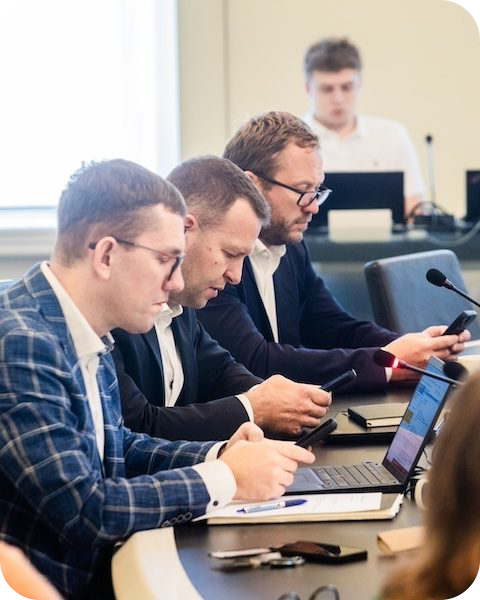
There is good news. The economy appears to be coming out of its doldrums, and these taxes, according to the prime minister, Kristen Michal (pictured above, in plaid sport coat), are the last his government will introduce in this term, which is set to end in 2027. After that, the plan is that they will go away.
He admits that the new taxes will chafe (indeed, some businesses fret they may buckle under because of them) but, on balance, knowing what the tax regime the next two years will be is preferable the uncertainty created by what he labelled as a “festival” of proposals in recent months.
“Predictability,” he says, “breeds certainty, and certainty breeds growth.”
One thing that is not certain is whether the tax will actually go away after 2027, according to multiple members of the cabinet. The military’s plan, for example, requires another €4bn that has not been allocated, and then there are domestic considerations, such as healthcare, which in 2028 alone will need €200m more than it is getting today.
“I can confirm that it will not be possible to abolish today’s taxes,” Lauri Läänemets, the interior minister, says.
Between Russia’s rock and Brussels’ hard place, there is still plenty of room for politics. All the more reason to pity the Estonian taxpayer.