


Posts Tagged ‘Germany’
Eight Baltic Sea electricity TSOs publish offshore system study to promote coordinated sea basin planning

The electricity Transmission System Operators (TSOs) of eight countries bordering the Baltic Sea today published the first comprehensive regional system study for offshore network infrastructure and offshore wind, marking a significant step toward coordinated sea basin planning in Europe.
The TSOs of Denmark, Estonia, Finland, Germany, Latvia, Lithuania, Poland and Sweden – organised in the Baltic Offshore Grid Initiative (BOGI) – developed a study that moves from electricity transmission corridors to potential projects for the 2040-time horizon. The results show that the Baltic Sea region can become a clean energy hub, with around 13 GW of new cross-border interconnectors and up to 50 GW of additional offshore wind identified by 2040. These connections include point-to-point links between countries and strategic offshore nodes such as Bornholm, which could serve as future hybrid hubs. The market modelling indicates that these interconnectors would operate with high utilisation throughout the year and significantly reduce system costs, price peaks and CO₂ emissions.
Read full announcement (external link)
Originally published on 22 Jan
Read MoreMarket participants are invited to provide feedback on the Nordic–Baltic Hydrogen Corridor project

The implementers of the Nordic–Baltic Hydrogen Corridor project — the European gas transmission system operators “Conexus Baltic Grid” (Latvia), “Gasgrid Finland” (Finland), “Elering” (Estonia), “Amber Grid” (Lithuania), “GAZ‑SYSTEM” (Poland) and “ONTRAS” (Germany) — have launched a market survey, inviting market participants to express their views by completing a questionnaire on the cross‑border hydrogen infrastructure development project.
At this stage, market participants are invited to take part in shaping the development of the cross‑border hydrogen network by providing their perspectives on the creation of the Nordic–Baltic Hydrogen Corridor, which will strengthen Europe’s energy security and support the transition to a climate‑neutral economy.
Read full announcement (external link)
Originally published on 16 Jan
Read MoreOstwind 3 grid connection project on the home stretch: Offshore platform precisely installed in the sea off Rügen

The expansion of the grid connection systems for connecting offshore wind farms in the Baltic Sea is progressing well. 40 kilometres northeast of the island of Rügen, an important stage in the 50Hertz Ostwind 3 project has now been successfully completed – the installation of the Jasmund offshore platform. It is to collect 300 megawatts from the Windanker wind farm from October, transform it to the voltage level of 220 kilovolts and transmit the electricity via a submarine land cable connection to the new Stilow substation in the Vorpommern-Greifswald district, which is still under construction.
Stefan Kapferer, Chairman of the Management Board of 50Hertz: “After Ostwind 1 and 2, Ostwind 3 is the next project in the sea area northeast of Rügen, which we will complete on time and within budget. We are also on track with the next OST-6-1 project with a transmission capacity of 927 MW, which serves to connect the Gennaker wind farm north of the Fischland-Darß-Zingst peninsula. Two offshore platforms are already under construction, the laying of protective pipes has begun, and a new substation near Gnewitz is taking shape. Overall, 50Hertz is making a significant contribution to reliably tapping the great wind energy potential of the Baltic Sea – in German waters, but also beyond in cooperation with Energinet from Denmark and, in the future, with other partners in the Baltic region.”
Read full announcement (external link)
Originally published on 12 Jan
Read MoreGennaker offshore wind farm obtains construction and operations permit

Skyborn Renewables’ (Skyborn) permit application for its 976.5 MW Gennaker offshore wind farm, located in the German Baltic Sea and with a commissioning target date of 2028, has been approved on 16 December by the State Office for Agriculture and Environment in Stralsund, Western Pomerania.
The permit was handed-over to Skyborn today in Rostock. This achievement enables Skyborn to proceed to an anticipated Final Investment Decision (FID) in summer 2026, with construction planned to take place over a period of two years and commissioning in 2028.
Once operational, the Gennaker offshore wind farm will add up to 976.5 MW to Germany’s total renewable energy capacity and generate annually green electricity of 4TWh, equal to the annual consumption of approximately one million households.
Read full announcement (external link)
Originally published on 19 Dec
Read MoreICEYE and Rheinmetall win major contract worth billions for space reconnaissance

Rheinmetall and ICEYE have received a major order from the German Armed Forces for the space sector. The Federal Office of Bundeswehr Equipment, Information Technology and In-Service Support (BAAINBw) has commissioned Rheinmetall ICEYE Space Solutions to supply the German Armed Forces with space-based reconnaissance data via exclusive access to a synthetic aperture radar (SAR) satellite constellation.
To deliver this capability, Rheinmetall has partnered with ICEYE – the world’s leading manufacturer and operator of synthetic aperture radar (SAR) satellites – to establish Rheinmetall ICEYE Space Solutions. Based in Neuss, the joint venture will provide a high volume of SAR images via its exclusive constellation, offering a comprehensive service solution that includes full operations, ground station management, and AI-driven image evaluation. The satellite constellation remains the property of Rheinmetall ICEYE Space Solutions.
The current contract is valued at approximately €1.7 billion gross. Furthermore, an extension option is part of the contract. The space-based reconnaissance data will be used, primarily, to protect the ‘Lithuania Brigade’ and secure NATO’s eastern flank.
Read full announcement (external link)
Originally published on 18 Dec
Read MoreRWE to sell Polish offshore wind development project to PGE

RWE has signed an agreement with PGE for the sale of its F.E.W. Baltic II offshore wind development project in the Polish Baltic Sea. The wind farm has a planned capacity of 350 megawatts and will be located approximately 50 kilometres from shore, north of the Polish town of Ustka. The transaction is expected to be closed in the first quarter of 2026. The parties already completed the transfer of an Environmental Decision and related data for the adjacent wind development site 44.E.1. to PGE.
RWE remains fully committed to further support the Polish energy transition by developing, constructing and operating a diverse pipeline of renewable energy projects across Poland. Today, the company already operates onshore wind and solar farms with a combined capacity of more than 660 megawatts in the country.
Sven Utermöhlen, Chief Executive Officer RWE Offshore Wind: “We are convinced that, in synergy with their other portfolio, PGE is better positioned to realise this project than RWE would be on a standalone basis. However, our target to further grow our offshore wind portfolio remains unchanged. We are currently building four large-scale offshore wind farms in four European countries and have several further offshore projects under development.”
Read full announcement (external link)
Originally published on 18 Dec
Read MoreLeopard 2 A8 agreements signed by the MoD and international defence industry partners

The Ministry of National Defence and representatives of KNDS Deutschland, Rheinmetal Landsysteme and EPSO-G state-owned energy group international partners signed a Memorandum on industrial cooperation concerning constructions of Lithuania-based assembly and maintenance infrastructure for the Leopard 2 A8 main battle tanks. The project will be completed at a more efficient pace thanks to the major investment project statues granted by the Ministry of the Economy and Innovation.
25.1% of stocks of Lithuania Defense Services (LDS) owned by KNDS Deutschland and Rheinmetal Landsysteme are planned to be transferred to EPSO-G Invest. Parties prepare for agreement on cooperation terms in detail in 2026.
The Memorandum covers assembly of part of the tanks in Lithuania aiming for the shortest possible delivery terms and offer preconditions for capability development to the Lithuanian defence industry. In the wake of the agreement signature with the MoD, LDS will start building and assembly factory for the latest version of Leopard 2 A8. In its turn, Lithuania commits to contribute in developing the LSD manufacturing base and has signed an additional agreement on tank maintenance in combat-ready condition.
Read full announcement (external link)
Originally published on 11 Dec
Read MorePaul Brzesina to become Neptun Ship Design managing director
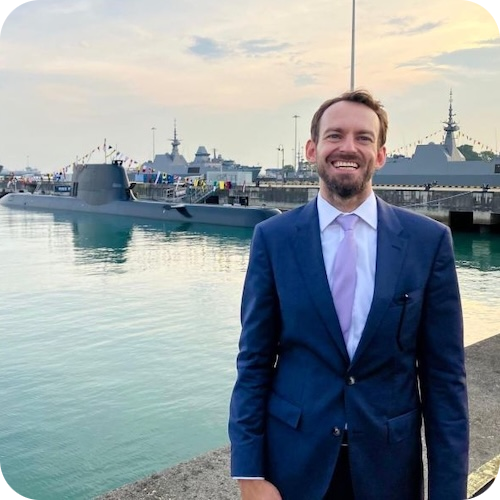
Experienced manager with a wealth of experience in the maritime industry moves to Rostock-based shipbuilder
Paul Brzesina has been named as the next managing director of Rostock-based Neptun Shipdesign.
He will start in the new position in January after 15 years with the TKMS group, the naval defence business of thyssenkrupp. In his most recent position, he served as the programme director of the Singaporean 218SG-class submarines and as managing director ofTKMS Singapore, the in-service support branch for the 218SG submarines.
Paul has a background in general management, is well versed in the maritime industry and ecosystems and possesses profound expertise in international sales and project management.
Read MoreGASCADE puts 400 kilometers of hydrogen core network into operation

GASCADE Gastransport GmbH (GASCADE) has reached a decisive milestone in building the German hydrogen network: about 400 kilometers of existing natural gas pipelines have been successfully converted to transport hydrogen. The initial filling of the first pipeline sections as part of the program Flow – making hydrogen happen establishes a North-South axis from the Baltic Sea region to Saxony-Anhalt, forming a central part of the German hydrogen core network. The hydrogen infrastructure is now available to the market and thus provides the basis for a successful hydrogen ramp-up.
This internationally unique project demonstrates how existing infrastructure can be quickly and cost-effectively transformed for hydrogen transport. GASCADE thereby creates planning security for the hydrogen ramp-up and makes a significant contribution to reducing CO₂ emissions in German industry. Managing Director Ulrich Benterbusch emphasizes the technical dimension and resulting opportunities: “With the successful conversion of 400 kilometers of pipeline, we reliably provide large-scale and central hydrogen infrastructure. Converting existing natural gas pipelines with a diameter of 1.4 meters to hydrogen is a technical pioneering achievement. This project is a strong signal for the German hydrogen economy and the industrial location of Eastern Germany.”
Managing Director Christoph von dem Bussche highlights the potential and the European perspective: Flow – making hydrogen happen is more than a technical project. It is a promise for the future. In 2025 we are creating the conditions to receive hydrogen from the European Baltic Sea region, international hydrogen imports via the port of Rostock, as well as green hydrogen produced on the Baltic coast – especially at the Lubmin site. From the get-go, we are considering the connection to our European neighbors. Because only together can we succeed in building a strong cross-border hydrogen economy.”
Read full announcement (external link)
Originally published on 11 Dec
Read MoreFassmer strengthens maritime manufacturing capabilities

The Fassmer Group is expanding its production capacities and establishing a new site in Stralsund. The company has leased facilities on the premises of the Volkswerft from the Hanseatic City of Stralsund. Operations are scheduled to begin in early 2026 with the construction of the new fisheries research vessel WALTHER HERWIG.
By setting up operations in Stralsund, Fassmer is strengthening its presence on the Baltic Sea while revitalizing the historic Volkswerft site. The region will regain an active maritime industry location – creating prospects for employment, value creation and regional cooperation.
Fassmer’s move into Stralsund marks the beginning of a strategic expansion. It reduces dependence on foreign supply chains, retains expertise within the country and contributes to the Federal Government’s security policy resilience.
Read full announcement (external link)
Originally published on 4 Dec
Read More