


Posts Tagged ‘Germany’
Leopard 2 A8 agreements signed by the MoD and international defence industry partners
The Ministry of National Defence and representatives of KNDS Deutschland, Rheinmetal Landsysteme and EPSO-G state-owned energy group international partners signed a Memorandum on industrial cooperation concerning constructions of Lithuania-based assembly and maintenance infrastructure for the Leopard 2 A8 main battle tanks. The project will be completed at a more efficient pace thanks to the major investment project statues granted by the Ministry of the Economy and Innovation.
25.1% of stocks of Lithuania Defense Services (LDS) owned by KNDS Deutschland and Rheinmetal Landsysteme are planned to be transferred to EPSO-G Invest. Parties prepare for agreement on cooperation terms in detail in 2026.
The Memorandum covers assembly of part of the tanks in Lithuania aiming for the shortest possible delivery terms and offer preconditions for capability development to the Lithuanian defence industry. In the wake of the agreement signature with the MoD, LDS will start building and assembly factory for the latest version of Leopard 2 A8. In its turn, Lithuania commits to contribute in developing the LSD manufacturing base and has signed an additional agreement on tank maintenance in combat-ready condition.
Read full announcement (external link)
Originally published on 11 Dec
Read MorePaul Brzesina to become Neptun Ship Design managing director
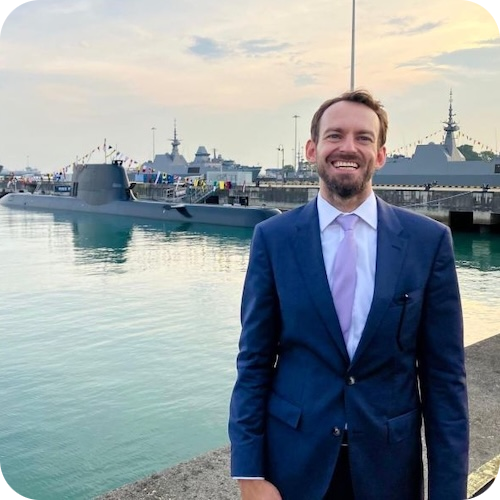
Experienced manager with a wealth of experience in the maritime industry moves to Rostock-based shipbuilder
Paul Brzesina has been named as the next managing director of Rostock-based Neptun Shipdesign.
He will start in the new position in January after 15 years with the TKMS group, the naval defence business of thyssenkrupp. In his most recent position, he served as the programme director of the Singaporean 218SG-class submarines and as managing director ofTKMS Singapore, the in-service support branch for the 218SG submarines.
Paul has a background in general management, is well versed in the maritime industry and ecosystems and possesses profound expertise in international sales and project management.
Read MoreGASCADE puts 400 kilometers of hydrogen core network into operation

GASCADE Gastransport GmbH (GASCADE) has reached a decisive milestone in building the German hydrogen network: about 400 kilometers of existing natural gas pipelines have been successfully converted to transport hydrogen. The initial filling of the first pipeline sections as part of the program Flow – making hydrogen happen establishes a North-South axis from the Baltic Sea region to Saxony-Anhalt, forming a central part of the German hydrogen core network. The hydrogen infrastructure is now available to the market and thus provides the basis for a successful hydrogen ramp-up.
This internationally unique project demonstrates how existing infrastructure can be quickly and cost-effectively transformed for hydrogen transport. GASCADE thereby creates planning security for the hydrogen ramp-up and makes a significant contribution to reducing CO₂ emissions in German industry. Managing Director Ulrich Benterbusch emphasizes the technical dimension and resulting opportunities: “With the successful conversion of 400 kilometers of pipeline, we reliably provide large-scale and central hydrogen infrastructure. Converting existing natural gas pipelines with a diameter of 1.4 meters to hydrogen is a technical pioneering achievement. This project is a strong signal for the German hydrogen economy and the industrial location of Eastern Germany.”
Managing Director Christoph von dem Bussche highlights the potential and the European perspective: Flow – making hydrogen happen is more than a technical project. It is a promise for the future. In 2025 we are creating the conditions to receive hydrogen from the European Baltic Sea region, international hydrogen imports via the port of Rostock, as well as green hydrogen produced on the Baltic coast – especially at the Lubmin site. From the get-go, we are considering the connection to our European neighbors. Because only together can we succeed in building a strong cross-border hydrogen economy.”
Read full announcement (external link)
Originally published on 11 Dec
Read MoreFassmer strengthens maritime manufacturing capabilities

The Fassmer Group is expanding its production capacities and establishing a new site in Stralsund. The company has leased facilities on the premises of the Volkswerft from the Hanseatic City of Stralsund. Operations are scheduled to begin in early 2026 with the construction of the new fisheries research vessel WALTHER HERWIG.
By setting up operations in Stralsund, Fassmer is strengthening its presence on the Baltic Sea while revitalizing the historic Volkswerft site. The region will regain an active maritime industry location – creating prospects for employment, value creation and regional cooperation.
Fassmer’s move into Stralsund marks the beginning of a strategic expansion. It reduces dependence on foreign supply chains, retains expertise within the country and contributes to the Federal Government’s security policy resilience.
Read full announcement (external link)
Originally published on 4 Dec
Read MoreWhen, not if Bornholm Energy Island
The concept behind an energy island is easy enough to understand: connect offshore windfarms to a converter station that can transform the electricity they generate to high‑voltage direct current and export it to markets where it is needed.
Indeed, in the case of Energy Island Bornholm, the matter should be even simpler: the converter station can be built on the island of Bornholm, about halfway between northern Germany and eastern Denmark—two markets that have said they want to buy the three gigawatts of electricity (enough to power as many as 4.5 million homes) the windfarms would produce.
READ MORE
What has not been so simple has been getting lawmakers to find the money for a project that has nearly doubled in cost since it was proposed in 2020 and now stands at 31.5 billion kroner (€4.15 billion). Uncertainty about whether Germany would still support the project after its federal elections this past February led to negotiations being suspended until May, but now it appears Berlin is eager for them to draw to a close.
Stefan Rouenhoff, a spokesperson for the German government, told an industry get-together on Bornholm on Monday that his country was willing to shoulder the larger share of the bill, and that he hoped a deal could be reached in time for it be announced on 26 January, when Germany hosts a wind-energy gathering of its own.
His comments echo earlier remarks from EU and Danish officials that an agreement is close. Other developments—from the EU’s pledge of €645 million as part of its wider energy‑security programme to the opening of public consultation in Denmark and Germany—suggest they are not exaggerating.
The industry appears to share their outlook. The meeting on Bornholm was the third of its kind, and, say the Danish hosts, the best attended, with representatives from all the key firms and agencies needed to bring Energy Island Bornholm on-line by 2030.
Also on hand were those looking for proof of concept for energy islands of their own, including one linking Åland, Gotland and Estonia’s Saaremaa. The real question, then, may be neither if nor when, but where.
Approval procedures for the Bornholm Energy Island project launched
An important milestone has been reached for the hybrid interconnector Bornholm Energy Island (BEI): first public consultations have started in both countries.
The transmission system operators 50Hertz and Energinet have jointly submitted an application to start the environmental impact assessment (EIA) to the Danish Environmental Agency SGAV for the “BEI Interconnector Bornholm-Germany.” To this end, in November 2025, the public on Bornholm and relevant stakeholders were invited to the first public consultation. In Germany, the first public consultation took place in April 2025.
Bornholm Energy Island is a European PCI project (project of common interest), and the approval procedures are therefore being carried out according to the European TEN-E regulation.
Read full announcement (external link)
Originally published on 28 Nov
Read MoreGermany and Finland: Cooperation strengthens position on the hydrogen market

It is the first of its kind in Finland: in the spring, an industrial-scale green hydrogen production plant went into operation in Harjavalta, Southwest Finland. It was built by the Finnish company P2X Solutions Oy, a pioneer in green hydrogen and Power-to-X technology. The company additionally plans to build further production plants in Joensuu and Oulu, aiming for a total hydrogen production capacity of 1 GW by 2031.
The arrival of the electrolysis plant in Harjavalta marked an important milestone for the production of green hydrogen.
The electrolysis system for hydrogen production in Harjavalta originates from Germany. More precisely from Dresden from Sunfire SE, a specialist in electrolysers.
Read full announcement (external link)
Originally published on 26 Nov
Read MoreConstruction of the Rheinmetall ammunition plant in Baisogala launched with an official ceremony
The joint German-Lithuanian 155-mm artillery ammunition plant near Baisogala is scheduled to commence operations by the end of 2026. This strategic facility will bolster Lithuania’s defence industry capabilities and contribute to ensuring national security. Today, 4 November, Minister of Energy Žygimantas Vaičiūnas took part in the symbolic ceremony marking the commencement of construction of the plant.
During the ceremonial launch, President of the Republic of Lithuania Gitanas Nausėda, Prime Minister Inga Ruginienė, Minister of Economy and Innovation Edvinas Grikšas, Minister of Energy Žygimantas Vaičiūnas, EPSO-G Group CEO Mindaugas Keizeris, and Rheinmetall CEO Armin Papperger symbolically marked the start of construction work on the facility.
“Energy goes beyond the boundaries of this sector. Today, energy security and national security are two inextricably linked areas. The EPSO-G Group has demonstrated its leadership by implementing strategic energy projects, such as the synchronisation with the continental European network, and is now doing so again by participating in a project of significance for both Lithuania’s and Europe’s security, while also integrating renewable energy,” says Minister of Energy Žygimantas Vaičiūnas.
Read full announcement (external link)
Originally published on 4 Nov
Read MoreEIB and Iberdrola sign a €500 million green loan for the Windanker offshore wind farm in German Baltic Sea
The European Investment Bank (EIB) has signed a €500 million green loan to Iberdrola for the Windanker offshore wind farm, a flagship clean energy project currently under construction in the German Baltic Sea.
The financing is guaranteed by the Spanish export credit agency, Cesce. This transaction with Iberdrola marks the inaugural use of a guarantee developed by the EIB and Cesce, to support green projects led by Spanish companies outside Spain, contributing to the European Union’s climate action and environmental sustainability objectives.
The new project will generate clean energy for thousands of homes, accelerate Europe’s electrification and energy security, driving new employment, economic opportunity, and state-of-the-art renewable energy innovation.
Read full announcement (external link)
Originally published on 3 Nov
Read MoreA delegation of more than 180 Latvian entrepreneurs begins a trade mission in Hamburg and Rostock
From September 24 to 26, Minister of Economics Viktors Valainis, together with 180 representatives of businesses and organizations, will participate in a trade mission to Hamburg and Mecklenburg-Western Pomerania. On September 25, Prime Minister Evika Siliņa will also join the trade mission to participate in a business forum and meet with senior officials from Mecklenburg-Western Pomerania.
This trade mission brings together more than 100 Latvian companies from various sectors – from biotechnology and sustainable energy to financial technology, information technology, and the defense industry.
Germany is the third largest economy in the world and one of the leading innovation and industrial powers. It is Latvia’s second most important foreign trade partner, with a total trade volume of €4.98 billion in 2024. Germany is also Latvia’s third largest export market, second largest import partner and main destination for Latvian service exports. In the first half of 2025, exports of goods to Germany increased by 4% to EUR 641.7 million, while exports of services increased by 6% to EUR 355 million.
Read full announcement (external link)
Originally published on 24 Sep
Read More