


Posts Tagged ‘sustainability’
Making ketchup green Baltic ports are taking a piecemeal approach to fossil-free shipping

It will only get the region so far
Read More€1,6 billion in EIB Group financing backed Finland’s green transition and innovation in 2025

In 2025, the European Investment Bank (EIB) and the European Investment Fund (EIF), which together form the EIB Group, provided financing to Finnish public sector bodies and companies across a range of sectors, from sustainable transport and social infrastructure to advanced technologies and small business finance. The funding supported climate action, energy security, innovation and access to finance for startups and small and medium-sized enterprises. Total EIB Group financing amounted to around €1,6 billion and the support helped mobilise total investments in Finland of about €4.9 billion – equivalent to 1.8% of GDP or €868 per person.
Among the year’s key projects was EIB support for new tram infrastructure in the Helsinki metropolitan area, strengthening sustainable urban mobility and reducing emissions from transport. The EIB also financed upgrades to hospitals and schools across Finland, improving energy efficiency and resilience in essential public services, as well as investments to enhance safety and reliability at the Olkiluoto nuclear power plant, supporting secure low-carbon electricity generation.
Read full announcement (external link)
Originally published on 4 Feb
Read MoreLatvia receives record-high EIB Group financing of €381 million in 2025
The European Investment Bank (EIB) Group increased financing for Latvia to a record €381 million in 2025 to speed up the green transition, strengthen infrastructure and promote loans for households and businesses. The EIB Group last year also opened its first office in Riga to anchor a closer partnership with authorities, companies and financial intermediaries in the country.
“2025 was a significant year for the EIB Group in Latvia,” said EIB Vice-President Karl Nehammer. “With record financing and our new office in Riga, we are now closer to our partners than ever before – supporting energy security, modern infrastructure and better access to finance for people and businesses across the country.”
Read full announcement (external link)
Originally published on 30 Jan
Read MorePort of Helsinki’s first standardised sustainability report published

Port of Helsinki Ltd published its first sustainability report based on the VSME-standard on December 4, 2025. The comprahensive voluntary report covers Port of Helsinki Lts’s operations in 2024. Standardised reporting improves the comparability of the operations of participating companies.
“We have long had ambitious sustainability commitments and targets in place, for example regarding carbon emissions, and have reported on them annually in accordance with our own practices. However, we are now adopting a new way of presenting existing information in accordance with the VSME standard,” says Head of Sustainability & HSEQ Andreas Slotte from the Port of Helsinki.
The Port of Helsinki’s operations are under pressure due to the growing expectations of owners, customers and e.g. ship passengers regarding responsible and sustainable operation. At the same time, legal requirements are also becoming stricter.
Read full announcement (external link)
Originally published on 4 Dec
Read MoreTallinn wins ITB Earth Award 2025 for zero-waste festival initiative

Tallinn’s story of a zero-waste Song and Dance Celebration has won the ITB Earth Award 2025 at the Green Destinations Top 100 Story Awards competition, one of the world’s largest tourism fairs held in Berlin. The award highlights Tallinn’s innovation and commitment to sustainability as a tourism destination.
Read full announcement (external link)
Originally published on 5 Mar
Read MorePlug-in holiday Stockholm’s ports are helping the cruise industry clean up its act
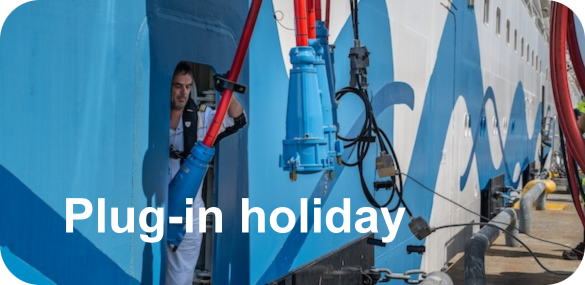
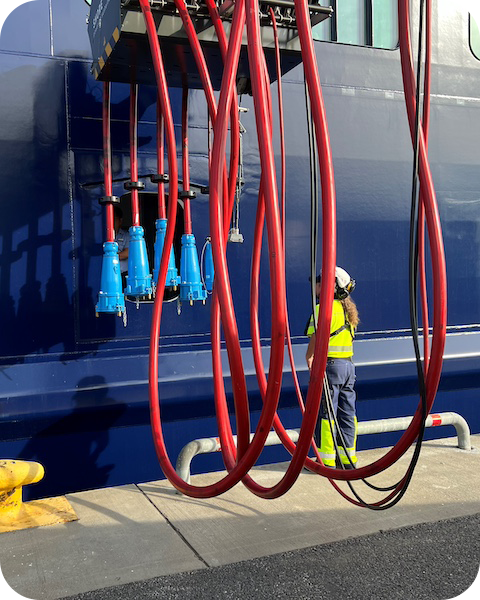
Shore-side power has become a major focus of the cruise industry’s efforts in recent years to reduce its environmental impact. It should come as no surprise, then, that Ports of Stockholm, the port authority overseeing the Swedish capital’s three main ports, made a big deal out it when it inaugurated the country’s on-shore power supply (or OPS) facility for international cruise ships on 17 September, making Stockholm the first port in Sweden—and one of just a handful in Europe—to allow cruise ships to power down their engines while in port.
Unlike a lot of other environmental initiatives, the benefits of on-shore power are immediately visible. For ships, being able to plug in, rather than run their engines, means no exhaust belching out of their smokestacks while in port.
This is because, in addition to propulsion, the diesel-electric engines that power most modern cruise ships also generate electricity. Often, more than half of an engine’s output is used for things like charging phones and keeping the lights on. Those are things that cannot be shut off entirely when the ships are in port.
Being able to plug in, more or less the way you would plug in an electric car, means less air pollution in the immediate vicinity of the ship, just as it also cuts out the noise the running engines generate. In places where the power is generated using renewable energy—such as Sweden’s hydroelectric or wind power—switching to on-shore electricity from on-board bunker brings down carbon pollution.
Read more
For now, about half of the cruise ships that land at one of Port of Stockholms’ ports can connect to electricity. This is more than double the amount that could a few years ago. By 2028, three quarters of the world’s cruise ships are expected to be able to plug in, according to CLIA, an industry group.
For cruise operators, there is an incentive in being a first mover, if it makes it possible to attract those who are turned off by the industry’s tarnished image. The promise of financial gain will undoubtedly speed the process along, but ports themselves can also play a role, either by directly mandating that ships be able plug in or by holding carrots.
Ports of Stockholm, for example, already offers discounts on port fees for ships that exceed emissions standards for carbon dioxide and soot. These could be extended to include on-shore power.
Paying ships to run cleaner makes more than just environmental logic, according to Jens Holm, the chair of the Ports of Stockholm board. It and three other Baltic Sea ports, Copenhagen/Malmö, Aarhus and Helsinki, all received funding from the EU to install OPS—amounting to 20% of the total €76mn the four port authorities will spend to do so—and he reckons this can help the Baltic Sea region market itself as a green cruise destination.
Mixing water and electricity may, in this case at least, not be such a bad idea after all.