


Concise news summaries, often with the benefit of at least 24 hours of hindsight
The concept behind an energy island is easy enough to understand: connect offshore windfarms to a converter station that can transform the electricity they generate to high‑voltage direct current and export it to markets where it is needed.
Indeed, in the case of Energy Island Bornholm, the matter should be even simpler: the converter station can be built on the island of Bornholm, about halfway between northern Germany and eastern Denmark—two markets that have said they want to buy the three gigawatts of electricity (enough to power as many as 4.5 million homes) the windfarms would produce.
READ MORE
What has not been so simple has been getting lawmakers to find the money for a project that has nearly doubled in cost since it was proposed in 2020 and now stands at 31.5 billion kroner (€4.15 billion). Uncertainty about whether Germany would still support the project after its federal elections this past February led to negotiations being suspended until May, but now it appears Berlin is eager for them to draw to a close.
Stefan Rouenhoff, a spokesperson for the German government, told an industry get-together on Bornholm on Monday that his country was willing to shoulder the larger share of the bill, and that he hoped a deal could be reached in time for it be announced on 26 January, when Germany hosts a wind-energy gathering of its own.
His comments echo earlier remarks from EU and Danish officials that an agreement is close. Other developments—from the EU’s pledge of €645 million as part of its wider energy‑security programme to the opening of public consultation in Denmark and Germany—suggest they are not exaggerating.
The industry appears to share their outlook. The meeting on Bornholm was the third of its kind, and, say the Danish hosts, the best attended, with representatives from all the key firms and agencies needed to bring Energy Island Bornholm on-line by 2030.
Also on hand were those looking for proof of concept for energy islands of their own, including one linking Åland, Gotland and Estonia’s Saaremaa. The real question, then, may be neither if nor when, but where.

Saab, a Swedish industrial group, has been chosen to deliver three submarines to the Polish navy. The deal will see the first sub delivered as part of the 10 billion zloty (€2.3 billion) Orka programme in 2030.
Even before Moscow’s unprovoked war on Ukraine, in 2022, Poland was one of Europe’s biggest military spenders. Since then, it has expanded investments in its armed forces further, and today its military spending amounts to 4.48% of its gross domestic product, the highest in Nato.
The Orka programme makes up a big chunk of that increase, and, say proponents, the subs are necessary for Poland to protect maritime infrastructure. Currently, Poland has one operational submarine, the ORP Orzeł. Built in the Soviet Union in 1985, it has a reputation of spending more time in repair than at sea.
Saab’s offer was chosen over five other bids, in part, because its model is specifically developed to operate in the Baltic. “The Swedish offer is the only one that met all the expectations of the navy,” Wladyslaw Kosiniak-Kamysz, Poland’s defence minister, said. Nothing under the sea apparently comes close either.
For someone from Denmark, the idea of accessing digital services or personal documents on-line is rather old-fashioned. The country is on version 2.0 of its national eID, and some 97% of residents over 15 use it to access all manner of public services. The private sector can also be partly thanked for the uptake: many firms have adopted the system as the login for their services as well.
Denmark stands out when it comes to eID, but it is not alone. All of the countries of the NB8, the club of eight Nordic and Baltic countries, can be found near the top the UN’s rankings of public services available on-line. Facilitating this requires giving residents reliable ways of verifying themselves—and forcing them to use it. The latter is an irritation in the start, but familiarity, as the Danish case shows, breeds content.
That should make the next goal something of a tip-in: this week, the countries’ digitalisation ministers agreed to pool their experience in order to be among the first EU members to roll out an eID that can be used in the entire bloc.
Brussels has stipulated that, by the end of next year, all members must offer at least one form of eID. Being a first-mover, the thinking amongst the NB8 goes, will allow the countries’ software developers to stay ahead of the pack, making their systems attractive to countries that will not have an eID solution of their own ready by the deadline. When it comes to identification technology, the biggest selling point may be reputation.
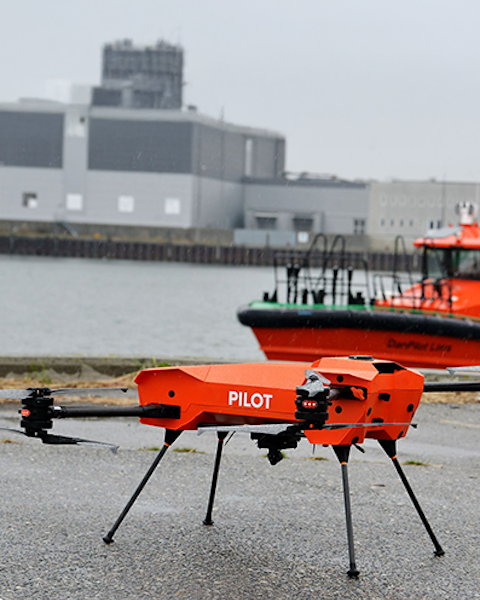
The concept of a maritime pilot is simple: a local mariner boards a vessel that is sailing unfamiliar waters and steers it safely through. Two projects being run by Danpilot, the Danish state pilot agency, may redefine key aspects of that job description.
In the first, begun last month, drones are being used to assist pilots operating on the water in the Port of Rønne, sending live aerial video to give pilots a top-down view when steering ships. Rønne serves as the staging point for several windfarms being built in the Baltic, and it is just this type of bulky traffic requiring complex manoeuvring the drones are well-suited to help with.
VesCo, the DanPilot-owned firm that is conducting the project, is hoping it will result in a system in which drones can automatically follow vessels to improve situational awareness, cutting risk during heavy-lift calls and reducing turn-around time.
A separate project, being run together with Danelec, a maritime-safety firm, may take this idea a step further by keeping the pilot on land entirely and instead navigating using the video beamed down by drones.
Trials in Esbjerg, on Denmark’s North Sea coast, suggest that using drones in this way makes piloting safer and faster. For local firms, the test flights are an opportunity to push their expertise in robotics and autonomy. Pilots, meanwhile, will be finding themselves in unfamiliar job territory.
School-born Startup Joins Google-Funded Accelerator to Reinvent Learning Discussions have been increasing in Lithuania about how artificial intelligence will change learning – but BBright is already doing it. The team founded just a few years ago is now helping thousands of school pupils in Lithuania to learn maths more efficiently, and the Elicėjus platform they are developing has already been recognised internationally. It has been recently selected for the Google.org-funded Grow AI Accelerator and received USD 140 000. The idea to create a personalised learning platform came from personal experience rather than from market analysis, since both Mantas Vičius, the co-founder of the platform, and his classmates struggled with maths at school. “We didn’t know where to start – the gaps kept piling up, until eventually we didn’t know where exactly we were stuck,” he says. Having subsequently examined the national statistics, they realised that it was a systemic problem: 35% of graduates fail the maths exam and 40% fail the evaluation of basic education achievements. Read full announcement (external link) Originally published on 18 Apr From 7 to 10 April this year, the global passenger cruise industry met in the heart of Miami for the 40th edition of Seatrade Cruise Global – the largest and most important event in the cruise shipping calendar. The Port of Gdańsk, which traditionally represents Poland on the international stage, had to be among this group of exhibitors and business people from all over the world. Although the Seatrade Cruise Global trade fair is mainly associated with Florida today, its origins date back to 1985, when the first edition of this event was held in New York. The anniversary fair brought together representatives of the largest shipowners, ports and tourist organisations, who discussed the future of passenger cruises, sustainable development and technological innovations. Originally published on 18 Apr Ignitis Renewables, an international green energy company, has completed the first stage of the largest wind energy project in Lithuania and the Baltics, Kelmė wind farm. The 114-megawatt (MW) Kelmė wind farm I has successfully reached the commercial operations date. “Kelmė wind farm I is the largest wind energy project implemented by Ignitis Renewables in Lithuania to date. This is one of the cornerstone projects that will allow us to move firmly towards our main goal of reaching 4–5 gigawatts (GW) of installed green generation capacity by 2030. This stage marks the increase in local electricity generation as well as the creation of a more secure energy system domestically and across the region,” says Darius Maikštėnas, CEO of Ignitis Group. Read full announcement (external link) Originally published on 17 Apr