


Copenhagen to send 10mn kroner to Bornholm to promote energy jobs

The Danish government plans to earmark 10mn kroner (€1.34mn) to allay concerns on the island of Bornholm that a planned 3GW interconnector will not benefit the local economy.
The proposed funding is included in a proposed national rural-development plan unveiled today.
Slated for completion in 2030, Energy Island Bornholm will consist of a 3GW windfarm off the southern coast of Bornholm and two on-shore interconnectors that will link the windfarm with Germany and the Greater Copenhagen area.
Despite local support for the windfarm, there has been concern about the placement of the interconnectors, which will occupy 100 hectares along the coast of the popular holiday destination, as well as the likelihood that none of the power generated by the windfarm will be available to the island’s residents or firms.
The Bornholm island council hopes that a proposed business park adjacent to the interconnector station could be powered by the windfarm, making it a selling point that could lead to the creation of new jobs. Søren Møller Christensen, the director of Baltic Energy Island, an Ørsted Wind Power-funded group seeking to promote energy innovation on Bornholm, reckons that the funding could be used to pay for the business park.
“If we’re giving up land for Energy Island Bornholm, then Bornholm needs to get something back that secures Bornholm’s economy in the long run. And this is something we can do with this money,” Mr Christensen told TV2/Bornholm, a local news outlet.
Copenhagen has earmarked half of the expected 31.5bn kroner the project is expected to cost.

When they meet in Oslo tomorrow, the 87 delegates to the Nordic Council, a gathering of legislators from the region, will be asking each other if they are ready for the next crisis.
Strictly speaking, issues like foreign affairs, defence and security are not within the remit of the Nordic Council. The fact that its semi-annual session will again have the issue on its agenda anyway reflects two things: one, the pressing nature of the matter, and, two, the region’s growing reliance on a strategy known as “total defence”.
READ MORE
Since the start of Moscow’s unprovoked war against Ukraine, the Nordic and Baltic countries, fearing they are next, have been pumping a lot of money into their militaries, with Denmark’s prime minister going so far as to order the country’s generals to go on a shopping spree.
Total defence makes that spending go a little further by giving the private sector and ordinary civilians a role to play during times of crisis—at a minimum, by making sure they can take care of themselves, so that the public sector and the military can concentrate on the most immediate threats. The thinking is that involving populations in emergency preparedness means they know what to do in the event something happens, and, not least, how to get themselves ready for it. Call it prepping, Nordic style.
FURTHER READING
} Nordic-Baltic Total Defence: Easier Said Than Done (Heinrich Böll Stiftung)
} Lithuanian opposition presents alternative defence plan, calling for total defence concept (LRT)
} Strengthening civil preparedness in the Baltic Sea Region (Diis)
} Focus on preparedness and total defence when Presidium of the Nordic Council met in Iceland (Nordic Council)
} “Finns understand that everyone has a role to play” (Helsinki Security Forum)
} Nordic Council Theme Session 2026 (Nordic Council)
} Total defence (Government offices of Sweden)
} A new era for Nordic security and preparedness (Nordic Council)
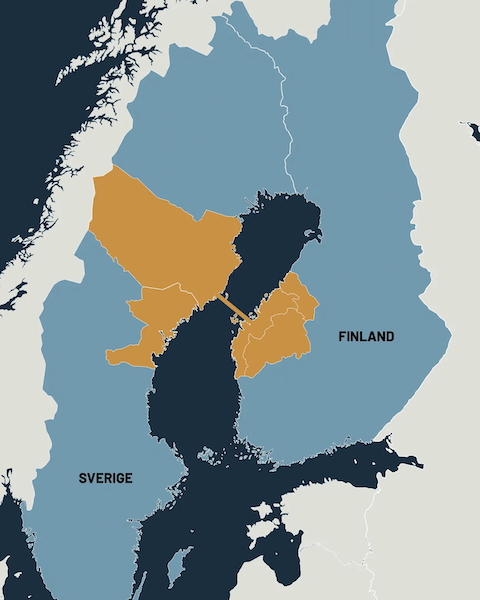
As far as building 100km bridges go, spanning the Kvarken, a narrowing of the northern Gulf of Bothnia, would be an easy task. Thanks to relatively shallow water, a generally firm seabed and an archipelago on the Finnish side, the challenge would lie less in getting the thing built than it would with coming up with the billions euros it would cost. (Estimates range from €5bn to €100bn.)
For that reason, when the idea has come up in the past, it has been easy for lawmakers in Sweden and in Finland to dismiss it as a costly white elephant that would have little benefit compared with the existing ferry service.
READ MORE
These days, though, the calculus that drives the cost-benefit analyses of such projects has a new variable: security. Where the idea of a better-connected region has long been framed in economic terms, a bridge across the Kvarken is increasingly being discussed as a way for Finns to remain connected to Europe in the event Russian shenanigans render the Finnish-Swedish land border unusable.
For now, a Kvarken bridge remains well over the horizon: a report published last year by Finland’s transport ministry reckons that the earliest one could be open for traffic would be the early 2040s. Still, proponents are bullish: the same report found a bridge was technically feasible and laid the foundation for an assessment of its economic benefits. A journey of a hundred kilometres begins with a single report.
FURTHER READING
} Fixed link across the Kvarken discussed in the Swedish Parliament (Kvarkenrådet)
} The €30-billion bid to link Finland to the wider EU (The Parliament)
} Finland wants to build a bridge across the Baltic Sea to Sweden for better connections to Europe (Euronews)
} Huge bridge between Sweden and Finland back on the drawing board (Ingeniøren)
} Kvarken Fixed Connection Feasibility Study (Väylävirasto)
A temporary reduction in the value-added tax on food items takes effect in Sweden today. As part of an 80 billion kronor (€7.35 billion) package passed in September aimed at supporting households and the economy, particularly in response to rising food prices and inflation, Swedes will pay 6% on retail food items until the end of 2027. (To the ire of restaurateurs, the VAT on prepared foods eaten on premises will remain at 12%.)
For the average family, the savings are expected to add up to 6,500 kronor (€594) per year, and the hope among the lawmakers who agreed on the reduction is that voters will remember where the money came from when they go to the polls later this year. But with an annual median income in the neighbourhood of 400,000 kronor, Swedes will be more concerned that the reduction will be paid for by reduced spending on other programmes.
READ MORE
Rising fuel prices stemming from the closing of the Strait of Hormuz also threaten eat up any savings at the supermarket. But there is a tax cut for that too: starting on 1 May, the government will reduce fuel duties to the EU minimum, in effect, extending until September a reduction that has been in place since 2022.
Note: This article originally incorrectly stated that all prepared foods will continue be assessed a 12% VAT. Sorry.
FURTHER READING
} Sweden to temporarily halve food VAT in election-year budget (Reuters)
} Sweden: VAT for food is lowered (Nordea)
} Sweden’s gasoline tax cuts make driving cheaper — but at what cost? (Stockholm School of Economics)
} Sweden’s government to cut taxes on petrol and diesel (Svergies Radio)
Moscow has resumed shipments of crude oil from two Baltic Sea ports near St Petersburg after a drone attack damaged a loading facility at Primorsk on Sunday. A second facility, at Ust-Luga, was closed as a precaution but re-opened after authorities lifted an attack alert. The two ports are major outlets for Russian oil, and the attack was a part of Ukraine’s strategy of targeting oil refineries in order to disrupt Moscow’s war economy.
Countries of the Baltic Sea region would like to see traffic to and from Primorsk and Ust-Luga stopped as well—for the added reason that the 1,000 or so ships that Russia uses to transport the oil and other banned items are not seaworthy, and they fear they will cause an accident. They are also suspected of being used by Moscow to sabotage undersea infrastructure.
READ MORE
But where Ukraine has the option of sending drones to accomplish its goals, Baltic Sea countries have had to tread more carefully for fear of provoking the Kremlin. That meant only stepping in when vessels posed an imminent danger, or when they were suspected of causing damage.
Now, though, their coast guards are becoming increasingly proactive. The Swedish coast guard, for example, boarded two vessels in a single week earlier this month. In one of the incidents, the captain was detained for “violating maritime code and the ship safety act, as well as the use of a forged document”. Those are hardly fighting words—but that is precisely the point.
A delegation of more than 100 representatives from Sweden, led by the country’s king, wrapped up a three-day visit to Poland on Wednesday that was focused on deepening security and economic co-operation between the two countries.
The visit comes as Stockholm and Warsaw are assembling defence forces that Moscow would think twice about tangling with. Both have shown that they can keep low-intensity harassment in the Baltic in check, but the bigger concern is whether they would be able to prevent a Russian land grab, and whether they could do so independent of American help.
READ MORE
A Polish-Swedish partnership is a match made in military-industrial heaven. Concerned that it does not have the modern kit needed to pose a credible deterrence, Poland is spending half of its defence budget—per capita the largest in Nato—on new equipment. That is more money than it can spend at home, and it has made Poland one of the biggest markets for Swedish arms exporters.
Saab’s sales of big-ticket items account for much of that, but there is plenty of potential for smaller firms to get in on the act, according to Business Sweden, a lobby group. It reckons that there are some 380 companies—many of them small and medium-sized—involved directly in arms production, and that vastly more making the civilian technologies that go into weapons. Modern warfare is good business for ploughshares that can be used as swords.
The eight Nato countries bordering the Baltic Sea, together with Iceland and Norway, have pledged to open their borders to each other’s citizens should they be forced to flee in the event of a disaster. The agreement is an extension of a patchwork of arrangements among some of the countries in the region and will make it possible to co-ordinate responses and establish uniform procedures for doing so.
The bear not in the room is Russia. The Kremlin has repeatedly said that it does not intend to invade Nato countries, but western intelligence agencies have advised their governments to be ready for everything from small-scale shenanigans to an outright invasion. Military collaboration has long been a way to signal to their populations that they are doing what they can to prevent such things from happening. Now, civil-defence agencies are showing they will be taken care of in the event they do.
RELATED ARTICLE } Swedes preparing to receive Bornholm refugees
The leading opposition party standing in Denmark’s general election on 24 March is suggesting that the 61 billion kroner (€816 million) in subsidies pledged by the Danish state last month to build Bornholm Energy Island would be better spent supporting the development of atomic power.
The proposal, put forward by Alex Vanopslagh, the leader of the Liberal Alliance, calls for taking a total of 120 billion kroner in subsidies for renewable-power projects and using the money fund construction of as many as eight atomic-energy plants over the next 15 years.
READ MORE
Though Bornholm Energy Island, which encompasses two offshore windfarms and an onshore power converter, is a Danish project, Germany is its biggest benefactor: in exchange for footing 70% of the bill it will get most of the power the windfarms generate.
The setup is one that the Danes worked hard to sell to Berlin, and would make it hard for Mr Vanopslagh to make good on his proposal without Denmark losing face. This is something he is well aware of, suggesting the purpose of making it has more to do with promoting his party’s position that Denmark should overturn its ban on atomic energy than it does with sinking an energy island.
Denmark has reactivated an air-force squadron that will operate four long-range drones to support surveillance of its interests in the Arctic, the North Atlantic and the Baltic.
The decision to purchase the American-produced MQ-9B SeaGuardians was announced last year, as was the three-year wait to have them delivered. But building up a drone corps in Denmark will take time as well; the air-force announced yesterday that it will need to hire and train a hundred or so people—many of them civilians—to keep the drones up and running.
READ MORE
The drone purchase is being made with the blank cheque the government gave the military last year, when it ordered it to procure the materiel it deems necessary to scale up its capacity as quickly as possible. Drones, it appears, fit that bill nicely: the SeaGuardians join four saildrones that were sea-trialled in June in preparation for surveillance operations in the Baltic. Compared with crewed systems, the drones are cheap and quickly rolled out.
The saildrones are also American-made, however—a fact that does not sit well with those who would prefer that the military start buying more of its kit in Europe. Other European armies are stocking up on American arms too, though: Germany, Belgium and Poland are all buying SeaGuardians. The saildrones’ producer, for its part, has chosen to set up a European sales office in Copenhagen. Denmark is unlikely to be the last country American drones take over.
When it comes to corruption rankings, there are the Nordics and then there is everyone else. Again this year, Denmark, Finland, Norway and Sweden ended in a log jam at the top of the Corruption Perceptions Index, an annual ranking of perceived corruption in the public sector. Germany rounded out the top 10. The Baltic states (Estonia: 12; Lithuania: 28th; Latvia: 37) are showing that despite some setbacks (including the resignation of Lithuania’s prime minister last year amid a corruption scandal), that they, too, take corruption seriously.
Transparency International, which has produced the report each year since 1995, cautions against easing up against corruption, even in the Nordic countries, but, in the Baltic region, the trends at least are with them: countries with the best records are generally democratic and highly digitalised.
READ MORE
That will show the path for Poland (52). To be sure, it has shown improvement since PiS, an illiberal regime that dismembered the country’s civil-society infrastructure, was voted out of office in 2023, and it finds itself solidly in the top third of the table.
Progress, though, has been modest, due to what has been deemed insufficient efforts to undo the damage done by PiS. Russia (157) finished level with Chad, Honduras and Zimbabwe. An outlier in a sea of outliers.
Eolus, a Swedish renewable-energy firm, announced last week that it had given up all but one of its offshore wind projects in the country.
The decision was not due to a lack of wind resources; starting in 2021, Eolus began expanding its capacity after evaluating that offshore wind would be necessary—and sufficient—for Stockholm to achieve its power-production targets. Eolus eventually built up a portfolio of projects with a planned capacity of 8.8MW. It blames a slow pace of electrification, as well as regulatory barriers and a lack of political support for making offshore wind unprofitable.
READ MORE
Eolus is not alone in its assessment. Earlier this month, RWS, a German firm, sold its Swedish offshore activities, stating that it was looking for a more dynamic market.
On paper, at least, Sweden fits that bill: it is already one of Europe’s largest onshore producers, and, with coastlines along both the North and Baltic seas and an estimated potential in excess of 100MW, it could also be one of its largest offshore producers. That it is not on its way to being so stems, in part, from a 2024 decision by the government to cancel 13 wind farms planned for the Baltic, totalling 32MW and €47 billion in investments.
The cancellation was made due to concerns that Baltic windfarms would just be another target for Russian shenanigans, and that the decision was made on the advice of the military. The industry says that does not explain why Sweden fell behind in the first place.
Sweden, it points out has 0.2GW of offshore windfarms, while neighbouring Denmark has up 2.6GW up and running. It also points out that the other countries of the Baltic have been able to balance security concerns with energy needs—and indeed incorporate them.
Domestically, the 13 cancelled projects, all of them to have been built in the south, would have been a way for Sweden to balance its grid; currently, producers in the north, where there is a surplus, may only send a limited amount of power to the south, where consumption outstrips demand. By removing the targets, Sweden may be shooting itself in the foot.