


Posts Tagged ‘Bornholm’
Plenty to go round Foreign labour on Bornholm
A frequent topic of discussion on Bornholm is the island’s declining population. Despite efforts to attract new residents, more islanders die or move off the island each year than can be replaced by birth or in-migration. One bright spot has been the number of foreigners coming to the island to work. One in eight jobs is held by a non-Dane; in 2008, it was one in 30. That is the largest per-capita increase in Denmark in the period, and it was enough to help the island keep its workforce stable.
The typical foreigner still works in hospitality or agriculture—where they have all but become indispensable for firms—but the shrinking workforce means there are a growing number of opportunities for them in a broader range of fields. There may be soon be new jobs where their labour will be needed: Energy Island Bornholm, a power-converter for offshore wind energy, is expected to create some 1,500 temporary construction jobs, and then perhaps 1,000 permanent jobs running, maintaining and serving the facility. As yet, the energy island is only a proposal, but the workforce it will need is already charging up.
Read MoreJENSEN-GROUP strengthens its North American presence with the acquisition of G.A. Braun

JENSEN North America, a subsidiary of the JENSEN-GROUP, is pleased to announce the acquisition of the business of G.A. Braun. This strategic move marks a significant milestone in the growth strategy of the JENSEN-GROUP, expanding its manufacturing footprint, product portfolio, and service network across North America.
Founded in Syracuse, New York, G.A. Braun is a respected supplier with a well-established brand in the laundry equipment market in North America. The acquisition reflects JENSEN-GROUP’s strong commitment to the North American market and its long-term strategy to strengthen local operations and manufacturing capabilities.
With this acquisition, JENSEN gains access to Braun’s state-of-the-art production facility with a strong reputation and a loyal customer base. Both brands will continue to co-exist, building on their respective legacy and customer relationships. This approach allows both JENSEN and Braun to preserve what makes each brand unique, while joining forces to deliver even greater value, innovation, and support to customers across North America.
Read full announcement (external link)
Read MoreStillstrom and Port of Roenne collaborate to unlock large-scale maritime electrification at Energy Island Bornholm

Stillstrom by Maersk and Port of Roenne have initiated a joint white paper to explore how Energy Island Bornholm could serve as a blueprint for integrating offshore wind energy with maritime electrification.
The new study, Energy Island Bornholm Powering Maritime Electrification, examines how renewable power production and future grid capacity can support charging solutions for electric ferries, cargo vessels and offshore service vessels – important steps to help shipowners invest in battery-powered fleets and advance the decarbonisation of European transport beyond road electrification.
Conventional cargo vessels passing Bornholm consume considerable amounts of fossil fuel every year. As battery technology continues to mature, battery-driven vessels are becoming increasingly viable. Stillstrom by Maersk, a marine technology leader delivering offshore power and charging solutions estimates that electrifying this segment would require around 17 TWh of new electricity consumption charging the battery-powered vessels replacing annually – in the range of – 3 million MT of marine gas oil (MGO) and roughly save €2 billion in oil imports.
Read full announcement (external link)
Originally published on 2 Dec
Read MoreDenial of service Gov’t told to pull plug on Bornholm’s TV station
Proposed adjustments to the public-service-media landscape in Denmark could cost Bornholm its sole TV station. Three recommendations handed down by an expert panel on Tuesday for the future of the eight regional TV stations all include eliminating TV2 Bornholm as an independent outlet.
The recommendations are hardly a surprise: part of the brief given the panel by the culture ministry was to find a way to rectify a situation in which all TV regions receive the same funding. TV2 Bornholm, the smallest TV region, serves 40,000 people, yet gets the same 71.8 million kroner (€9.34 million) each year as TV 2 Kosmopol, which serves the 1.9 people living in Greater Copenhagen.
Two of the experts’ recommendations would redraw the map entirely, either by combining funding for TV and radio production or by creating 30 semi-independent local news outlets.
The last calls for the creation of a third TV region in eastern Denmark, and to include Bornholm as part of the coverage area for one of them. This may be the one scenario the other regions can accept, since they generally would remain intact, and, in fact, is something they long have hinted would be fair. In its report, the panel seemed to suggest it agreed. “To ensure that Denmark as a whole is covered uniformly, it is necessary to take money away from TV2 Bornholm.”
The author is a member of the TV2 Bornholm board of directors.
Read MoreWhen, not if Bornholm Energy Island
The concept behind an energy island is easy enough to understand: connect offshore windfarms to a converter station that can transform the electricity they generate to high‑voltage direct current and export it to markets where it is needed.
Indeed, in the case of Energy Island Bornholm, the matter should be even simpler: the converter station can be built on the island of Bornholm, about halfway between northern Germany and eastern Denmark—two markets that have said they want to buy the three gigawatts of electricity (enough to power as many as 4.5 million homes) the windfarms would produce.
READ MORE
What has not been so simple has been getting lawmakers to find the money for a project that has nearly doubled in cost since it was proposed in 2020 and now stands at 31.5 billion kroner (€4.15 billion). Uncertainty about whether Germany would still support the project after its federal elections this past February led to negotiations being suspended until May, but now it appears Berlin is eager for them to draw to a close.
Stefan Rouenhoff, a spokesperson for the German government, told an industry get-together on Bornholm on Monday that his country was willing to shoulder the larger share of the bill, and that he hoped a deal could be reached in time for it be announced on 26 January, when Germany hosts a wind-energy gathering of its own.
His comments echo earlier remarks from EU and Danish officials that an agreement is close. Other developments—from the EU’s pledge of €645 million as part of its wider energy‑security programme to the opening of public consultation in Denmark and Germany—suggest they are not exaggerating.
The industry appears to share their outlook. The meeting on Bornholm was the third of its kind, and, say the Danish hosts, the best attended, with representatives from all the key firms and agencies needed to bring Energy Island Bornholm on-line by 2030.
Also on hand were those looking for proof of concept for energy islands of their own, including one linking Åland, Gotland and Estonia’s Saaremaa. The real question, then, may be neither if nor when, but where.
Approval procedures for the Bornholm Energy Island project launched

An important milestone has been reached for the hybrid interconnector Bornholm Energy Island (BEI): first public consultations have started in both countries.
The transmission system operators 50Hertz and Energinet have jointly submitted an application to start the environmental impact assessment (EIA) to the Danish Environmental Agency SGAV for the “BEI Interconnector Bornholm-Germany.” To this end, in November 2025, the public on Bornholm and relevant stakeholders were invited to the first public consultation. In Germany, the first public consultation took place in April 2025.
Bornholm Energy Island is a European PCI project (project of common interest), and the approval procedures are therefore being carried out according to the European TEN-E regulation.
Read full announcement (external link)
Originally published on 28 Nov
Read MorePRESS RELEASE
Bornholm is taking yet another important step toward becoming a national and international centre for green energy with a strong focus on innovation, education, and research in energy islands. Together with the Technical University of Denmark, Roskilde University, and Business Center Bornholm, the Baltic Energy Island Foundation has just received DKK 8.2 million from the Danish Board of Business Development to significantly expand the activities at Residential College Bornholm – the island’s hub for students, researchers, and businesses.
The total budget for the activities is DKK 12.6 million. Over the next three years, it will enable the development of new courses, field stays, summer schools, internships, student projects, and research activities in close collaboration with Danish universities and the local business community. This comes at a time when Bornholm is preparing for major investments and business opportunities linked to Energy Island Bornholm.
The project is carried out in collaboration with the Technical University of Denmark, Roskilde University, Business Center Bornholm, and Baltic Energy Island, and the ambition is to involve two additional Danish universities. This will significantly strengthen Bornholm’s access to knowledge, talent, and research capacity and create new opportunities for companies wishing to develop green technologies, solutions, and business models.
Read full announcement (external link)
Originally published on 27 Nov
Read MoreCapidea Acquires Majority Stake in HASLE Refractories A/S

Capidea is pleased to announce the acquisition of the majority stake in HASLE Refractories A/S, a Danish manufacturer of advanced refractory solutions for high-temperature industries including cement, steel, and waste-to-energy. Capidea has followed the company for a number of years and is now ready to embark on the next chapter together with Karen and Michael Bladt and the organization.
Building on HASLE’s strong foundation and recent recognition as a Børsen Gazelle 2025 company, an award recognizing Denmark’s fastest-growing businesses, the partnership will focus on developing the product portfolio and strengthening the organization to support continued international growth.
Carsten Riisberg Lund will continue as Chair of the Board, while Martin Jørgensen and former Capidea Partner Jens Thøger Hansen join Karen Bladt on the Board of Directors.
Read full announcement (external link)
Originally published on 19 Nov
Read MorePilot project In Rønne, drones are pointing the way to safer shipping
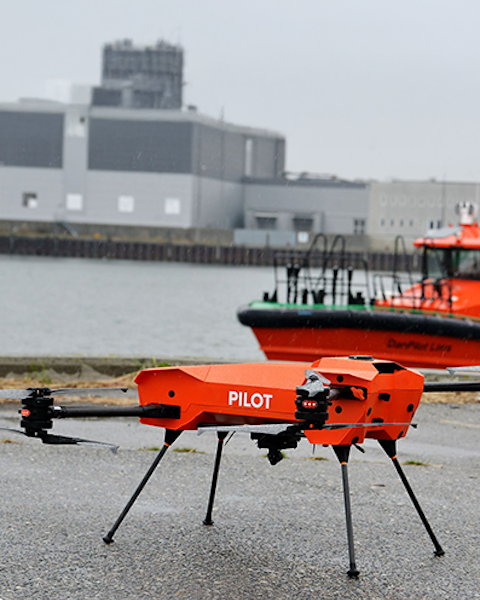
The concept of a maritime pilot is simple: a local mariner boards a vessel that is sailing unfamiliar waters and steers it safely through. Two projects being run by Danpilot, the Danish state pilot agency, may redefine key aspects of that job description.
In the first, begun last month, drones are being used to assist pilots operating on the water in the Port of Rønne, sending live aerial video to give pilots a top-down view when steering ships. Rønne serves as the staging point for several windfarms being built in the Baltic, and it is just this type of bulky traffic requiring complex manoeuvring the drones are well-suited to help with.
VesCo, the DanPilot-owned firm that is conducting the project, is hoping it will result in a system in which drones can automatically follow vessels to improve situational awareness, cutting risk during heavy-lift calls and reducing turn-around time.
A separate project, being run together with Danelec, a maritime-safety firm, may take this idea a step further by keeping the pilot on land entirely and instead navigating using the video beamed down by drones.
Trials in Esbjerg, on Denmark’s North Sea coast, suggest that using drones in this way makes piloting safer and faster. For local firms, the test flights are an opportunity to push their expertise in robotics and autonomy. Pilots, meanwhile, will be finding themselves in unfamiliar job territory.
Read MoreNew background analyses on the perspectives of Energy Island Bornholm
Baltic Energy Island has commissioned three analytical documents to serve as a foundation for discussions about the perspectives Energy Island Bornholm holds for Bornholm’s future development.
The studies follow up on a socio-economic analysis conducted by the Centre for Regional and Tourism Research (CRT) in 2023, which examined the local economic and employment effects of the Energy Island project.
Read full announcement (external link)
Originally published on 31 Oct
Read More