


Posts Tagged ‘Bornholm Energy Island’
Power play The EU’s energy upgrade
The European Commission has released its set of proposals for helping EU members to move some of the union’s most important energy projects forward. The measures were first aired in September by Ursula von der Leyen, the commission’s president, as a way to speed up projects that can make Europe’s energy net more resilient and—consumers will like this—its power cheaper.
In addition to cutting paperwork, the European Grids Package and the Energy Highways initiative will increase the amount of funding Brussels is willing to make available to big energy projects five-fold, to €30 billion. Ms von der Leyen had already identified the Harmony Link, connecting the Baltic states to Poland, and Energy Island Bornholm, an energy project that could serve as blue-print for hugely ambitious energy projects, as two of her eight highways towards the union’s power needs. Yesterday, she put the pedal to the metal.
Read MoreStillstrom and Port of Roenne collaborate to unlock large-scale maritime electrification at Energy Island Bornholm

Stillstrom by Maersk and Port of Roenne have initiated a joint white paper to explore how Energy Island Bornholm could serve as a blueprint for integrating offshore wind energy with maritime electrification.
The new study, Energy Island Bornholm Powering Maritime Electrification, examines how renewable power production and future grid capacity can support charging solutions for electric ferries, cargo vessels and offshore service vessels – important steps to help shipowners invest in battery-powered fleets and advance the decarbonisation of European transport beyond road electrification.
Conventional cargo vessels passing Bornholm consume considerable amounts of fossil fuel every year. As battery technology continues to mature, battery-driven vessels are becoming increasingly viable. Stillstrom by Maersk, a marine technology leader delivering offshore power and charging solutions estimates that electrifying this segment would require around 17 TWh of new electricity consumption charging the battery-powered vessels replacing annually – in the range of – 3 million MT of marine gas oil (MGO) and roughly save €2 billion in oil imports.
Read full announcement (external link)
Originally published on 2 Dec
Read MoreWhen, not if Bornholm Energy Island
The concept behind an energy island is easy enough to understand: connect offshore windfarms to a converter station that can transform the electricity they generate to high‑voltage direct current and export it to markets where it is needed.
Indeed, in the case of Energy Island Bornholm, the matter should be even simpler: the converter station can be built on the island of Bornholm, about halfway between northern Germany and eastern Denmark—two markets that have said they want to buy the three gigawatts of electricity (enough to power as many as 4.5 million homes) the windfarms would produce.
READ MORE
What has not been so simple has been getting lawmakers to find the money for a project that has nearly doubled in cost since it was proposed in 2020 and now stands at 31.5 billion kroner (€4.15 billion). Uncertainty about whether Germany would still support the project after its federal elections this past February led to negotiations being suspended until May, but now it appears Berlin is eager for them to draw to a close.
Stefan Rouenhoff, a spokesperson for the German government, told an industry get-together on Bornholm on Monday that his country was willing to shoulder the larger share of the bill, and that he hoped a deal could be reached in time for it be announced on 26 January, when Germany hosts a wind-energy gathering of its own.
His comments echo earlier remarks from EU and Danish officials that an agreement is close. Other developments—from the EU’s pledge of €645 million as part of its wider energy‑security programme to the opening of public consultation in Denmark and Germany—suggest they are not exaggerating.
The industry appears to share their outlook. The meeting on Bornholm was the third of its kind, and, say the Danish hosts, the best attended, with representatives from all the key firms and agencies needed to bring Energy Island Bornholm on-line by 2030.
Also on hand were those looking for proof of concept for energy islands of their own, including one linking Åland, Gotland and Estonia’s Saaremaa. The real question, then, may be neither if nor when, but where.
CEF Energy supports landmark Bornholm Energy Island interconnector between Denmark and Germany

CINEA has signed a grant agreement worth €645.2 million under the CEF Energy programme to support the Danish side of the Bornholm Energy Island (BEI) Hybrid Offshore Interconnector – one of Europe’s most ambitious and strategic energy infrastructure projects.
The grant signature ceremony took place on 4 September 2025 in Copenhagen, during the Informal meeting of energy ministers, marking a significant step towards a more resilient, interconnected, and sustainable European energy system.
Connecting offshore wind to millions of consumers
Led by Energinet (Denmark) and 50Hertz (Germany), this innovative and visionary project will connect multiple wind farms together via a single offshore energy hub on the Danish island of Bornholm in the Baltic Sea. From there, 3 GW of offshore green electricity will be brought onshore and distributed through Denmark and Germany, helping to power millions of homes and businesses with clean electricity.
To make this possible, CEF Energy is funding the construction of two new converter stations (one on Bornholm and one in Zealand), and the installation of an extensive submarine cable system of around 200 kilometres, complemented by a 17-kilometre onshore connection, between Zealand and Bornholm. This infrastructure will serve as a crucial bridge between offshore generation and consumers, enabling electricity to flow flexibly where it is needed most. This innovative setup supports energy security, price stability, and the integration of renewable energy on a much larger scale than before.
Read full announcement (external link)
Originally published on 4 Sep
Read MoreLarge-scale order for Siemens Energy to realise Danish-German Bornholm Energy Island project

The joint Danish-German Bornholm Energy Island project is moving from the planning and development stage to the implementation stage. The two transmission system operators Energinet (Denmark) and 50Hertz (Germany) placed a joint order with Siemens Energy for the construction and turnkey delivery of four converter systems in total as well as other technical components on the Danish island Bornholm and the Danish island Zealand as well as on the German mainland. This marks the end of a six-month transition phase during which the joint project had to be paused due to the need for political regulation between the two countries involved.
The contract that is now concluded between Energinet, 50Hertz and Siemens Energy covers the design, the completion, transport, installation, testing as well as commissioning of the systems by the mid-2030s.
Read full announcement (external link)
Originally published on 4 Sep
Read MoreNKT awarded the power cable connection between Bornholm Energy Island and Zealand in Denmark

Energinet, the Danish transmission system operator (TSO), has selected NKT to provide the 525 kV high-voltage direct current (HVDC) on- and offshore power cable systems for the Danish connection to the Bornholm Energy Island. The contract has a value of around EUR 650m and comprises design, manufacturing, and installation of a power cable system comprising 200 km offshore route and 16.8 km onshore route.
– We are delighted and proud to continue the long-term collaboration with Energinet on this innovative and ambitious project strengthening the interconnection between Denmark and Germany. Bornholm Energy Island is a key project for Europe to enhance energy security and the exchange of renewable energy. With this award, we reaffirm our strong commitment to building the sustainable and secure energy infrastructure Europe needs, and demonstrate our proven high-voltage power cable capabilities, says Claes Westerlind, President and CEO at NKT.
Read full announcement (external link)
Originally published on 4 Sep
Read MoreNo time at the present Bornholm’s green industry estate on stand-by
Bornholm should table its proposed industry estate until Copenhagen decides whether it will go ahead with its plans to build the converter station for two off-shore wind farms that would power the facility, an island council committee says.
A vote will be put before the full council later this month, but Jacob Trøst, the mayor, believes the national government’s decision in January to wait until after the German federal election to make its final decision makes proceeding impractical.
It is hoped that Germany will purchase the majority of the 3 megawatts of electricity the wind farms would produce. The rest is expected to be sent to eastern Denmark, but Bornholm would like some of it to be used to power an industry estate that would act as a crucible for energy start-ups.
Island businesses want work on the industry estate to continue. Questions like where it would be placed and when it would come on-line may be unanswerable at the moment, but, argues Michael Almeborg, the chair of the local chapter of DI, that should not stop the council from lining up the firms who will want to hear the answers when the council finally has them.
Read MoreEnergiø Bornholm has every chance of becoming a good business for Denmark
Doubts have been raised about Energiø Bornholm’s relevance and economy, but the project has never been more important. Besides being a crucial project in the European fight against climate change, the energy island has every opportunity to become a good business for Denmark.
Read full announcement (external link)
Originally published on 15 Jan
Read MoreWrong time to find right place for industry estate
Local lawmakers on Bornholm have voted down a motion to begin the process of identifying potential sites for an industry estate that could serve as a crucible for energy start-ups once a planned converter station for off-shore wind farms comes on-line.
Tendering for the converter station on the southern coast and two wind farms capable of powering 4.5 million homes has begun. Collectively known as Energy Island Bornholm, it is due to begin producing power in 2030, and that, according to a majority of the environment, nature and planning committee, is too far off—and the outcome of the project still far too uncertain—to being looking for places to place an estate.
Helle Munk Ravnborg, the committee chair, told TV2/Bornholm, a local broadcaster, that identifying sites for potential development while the future of Energy Island Bornholm was unclear, and before the full council has decided to build an industry estate, would be an unnecessary worry for property owners in or near areas selected as suitable sites.
The council’s finance and climate committee is due to consider the same question when it meets on Wednesday. If it is approved, the proposal will come before the full council.
Read MoreFantasy island Bornholm’s plans to power the Baltic are running headlong into reality
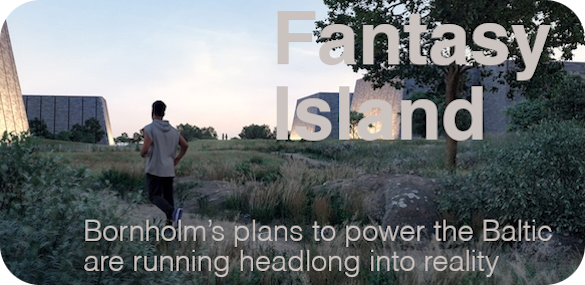
Bornholm is hoping that it can show the world what the future of wind power looks like. Its financing unfortunately resembles failed projects past
Read More