


Posts Tagged ‘Denmark’
Swedes preparing to receive Bornholm refugees
Amid Swedish fears of Russian expansionism in the Baltic, local authorities in Ystad say they are preparing for a situation in which they receive refugees from Bornholm.
Ystad is a Swedish council, but it is the mainland port for the primary ferry serving the Danish island.
The Swedish military considers Bornholm, along with other Baltic islands, as targets of potential Russian attacks, and that has led Ystad council to include refugees from the island in its civil-defence planning.
Police on Bornholm are responsible for co-ordinating civil defence. In the event of an attack, they say their directions would come from Copenhagen, but Ystad officials have called for co-ordination at the council level with Bornholm.
Source: Ystad Allehanda / TV2/Bornholm
Read MoreDenmark not ready for long-term defence buildup, business lobby warns
Danish manufacturers are at the ready to facilitate the rapid military buildup to the tune of 50bn kroner (€6.7bn) over the next two years announced by the prime minister on Wednesday. But they warn that any return to a military-industrial complex needed to sustain the military for the long-term will require more than just money.
“We should use this an opportunity to think strategically and truly modernise our society,” Lars Sandahl Sørensen, the managing director of DI, a business lobby, said. “Lawmakers won’t be able to avoid making considerable reforms, improving efficiency and investing in new technology and competitiveness.”
The additional funding comes on top of a 10-year, 190bn kroner plan to revamp the military, bringing it in line with Washington’s increasing demands that Nato members spend more on defence.
Denmark currently spends 2.4% percent of its gross domestic product on defence. That places it above the Nato target of 2%, but in January, Mette Frederiksen, the PM, told Danes to be prepared for cuts to some services, as her government looked towards spending 5% of GDP on defence in the coming years
Read more
The additional funding comes after years of cuts have hollowed out the military’s capabilities. And with Washington’s willingness to come to Europe’s aide in the event of a Russian attack now in doubt, Ms Frederiksen said the military would be allowed to fast-track purchases until it was rearmed, by-passing a lengthy and scandal-ridden tendering process.
Correction: We originally stated that the Nato spending target was 3%. Sorry.
British captain and ship operator sentenced over fatal 2021 collision
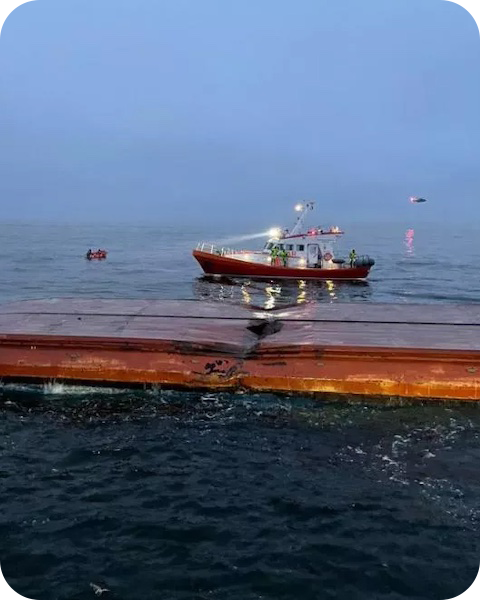
A court in Southampton, England, has sentenced the captain of a British cargo vessel and its operator for their roles in a December 2021 Baltic Sea collision that resulted in the deaths of two Danish seamen.
The crash occurred when the Scot Carrier, managed by Intrada Ships Management Ltd, collided with the Karin Høj, a Danish-registered barge, causing it to capsize. Investigators later determined that serious failures in watch-keeping and safety protocols contributed to the accident.
Sam Farrow, the 33-year-old master of the Scot Carrier, was sentenced on 14 Feb to eight months in prison, suspended for 12 months, for failing to prevent the collision, despite being aware that his second officer was unfit for duty. He was also ordered to pay £25,000 (€30,000) in legal costs.
Meanwhile, Intrada Ships Management Ltd was fined £180,000 and ordered to pay £500,000 in legal costs for failing to enforce safety measures that could have prevented the accident.
Read more
In 2022, a Danish court sentenced Mark Wilkinson, the second officer, to 18 months in prison after admitting to gross negligence and intoxication while on duty. Additionally, he received a 12-year ban from entering Denmark and had his maritime license revoked for operations in Danish waters.
(📸 Sjöräddningssällskapet)
Denmark to enforce ban on Russian ships
Denmark will start enforcing EU sanctions that prevent 27 Russian ships from entering Danish waters or anchorage sites, according to new guidlines issued by Danpilot, the national pilotage service. The ban also applies to services like bunkering and ship supplies.
The measure comes after Brussels in June adopted its 14th round of sanctions against Moscow in response to its unprovoked attack on Ukraine. These latest sanctions target the growing “shadow fleet” Moscow is said to be using to transport oil in violation of previous sanctions. They mark a significant step in the EU’s efforts to the Kremlin to comply with sanctions.
The shadow fleet has reportedly expanded to include between 360 to 1,400 vessels, representing a substantial portion of the global tanker market. The ships, often old and with unclear insurance and ownership, have only limited ties to Moscow, raising serious environmental concerns, particularly in the ecologically sensitive Baltic Sea region.
Reports suggest that they had continued to access Danish anchorages, just as it is unclear whether Danish pilots have begun enforcing the ban, but Russian officials have warned of potential retaliatory measures in response the latest round of sanctions.
Read more
This fleet’s existence underscores the challenges faced by the EU and its allies in curtailing Russia’s oil trade, which has been increasingly rerouted to the Kremlin’s allies amid tightening sanctions, indicating a shift in global trade patterns in response to sanctions.
Denmark’s geographical position makes it a crucial player in monitoring maritime traffic in the Baltic Sea, where a considerable volume of Russian oil passes through. Copenhagen is considering additional restrictions, motivated by the environmental risks posed by the vessels, but international maritime laws grant vessels the right to innocent passage, limiting its ability to enforce its ban without risking diplomatic tensions with Russia.
Copenhagen to send 10mn kroner to Bornholm to promote energy jobs

The Danish government plans to earmark 10mn kroner (€1.34mn) to allay concerns on the island of Bornholm that a planned 3GW interconnector will not benefit the local economy.
The proposed funding is included in a proposed national rural-development plan unveiled today.
Slated for completion in 2030, Energy Island Bornholm will consist of a 3GW windfarm off the southern coast of Bornholm and two on-shore interconnectors that will link the windfarm with Germany and the Greater Copenhagen area.
Despite local support for the windfarm, there has been concern about the placement of the interconnectors, which will occupy 100 hectares along the coast of the popular holiday destination, as well as the likelihood that none of the power generated by the windfarm will be available to the island’s residents or firms.
Read more
The Bornholm island council hopes that a proposed business park adjacent to the interconnector station could be powered by the windfarm, making it a selling point that could lead to the creation of new jobs. Søren Møller Christensen, the director of Baltic Energy Island, an Ørsted Wind Power-funded group seeking to promote energy innovation on Bornholm, reckons that the funding could be used to pay for the business park.
“If we’re giving up land for Energy Island Bornholm, then Bornholm needs to get something back that secures Bornholm’s economy in the long run. And this is something we can do with this money,” Mr Christensen told TV2/Bornholm, a local news outlet.
Copenhagen has earmarked half of the expected 31.5bn kroner the project is expected to cost.