


Posts Tagged ‘Denmark’
Capidea Acquires Majority Stake in HASLE Refractories A/S

Capidea is pleased to announce the acquisition of the majority stake in HASLE Refractories A/S, a Danish manufacturer of advanced refractory solutions for high-temperature industries including cement, steel, and waste-to-energy. Capidea has followed the company for a number of years and is now ready to embark on the next chapter together with Karen and Michael Bladt and the organization.
Building on HASLE’s strong foundation and recent recognition as a Børsen Gazelle 2025 company, an award recognizing Denmark’s fastest-growing businesses, the partnership will focus on developing the product portfolio and strengthening the organization to support continued international growth.
Carsten Riisberg Lund will continue as Chair of the Board, while Martin Jørgensen and former Capidea Partner Jens Thøger Hansen join Karen Bladt on the Board of Directors.
Read full announcement (external link)
Originally published on 19 Nov
Read MorePilot project In Rønne, drones are pointing the way to safer shipping
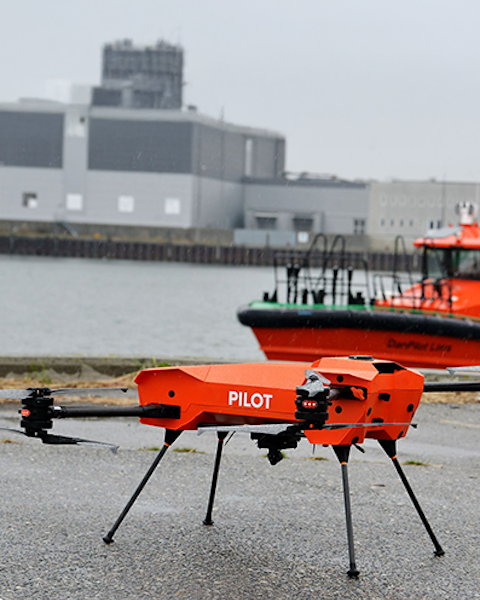
The concept of a maritime pilot is simple: a local mariner boards a vessel that is sailing unfamiliar waters and steers it safely through. Two projects being run by Danpilot, the Danish state pilot agency, may redefine key aspects of that job description.
In the first, begun last month, drones are being used to assist pilots operating on the water in the Port of Rønne, sending live aerial video to give pilots a top-down view when steering ships. Rønne serves as the staging point for several windfarms being built in the Baltic, and it is just this type of bulky traffic requiring complex manoeuvring the drones are well-suited to help with.
VesCo, the DanPilot-owned firm that is conducting the project, is hoping it will result in a system in which drones can automatically follow vessels to improve situational awareness, cutting risk during heavy-lift calls and reducing turn-around time.
A separate project, being run together with Danelec, a maritime-safety firm, may take this idea a step further by keeping the pilot on land entirely and instead navigating using the video beamed down by drones.
Trials in Esbjerg, on Denmark’s North Sea coast, suggest that using drones in this way makes piloting safer and faster. For local firms, the test flights are an opportunity to push their expertise in robotics and autonomy. Pilots, meanwhile, will be finding themselves in unfamiliar job territory.
Read MorePlural leads Teton.ai’s $20M Series A round

Teton.ai, a Danish predictive intelligence company that uses proprietary AI and computer vision technology to provide predictive care for older people, has raised $20 million in a funding round led by Plural. Other participants in the round include Bertelsmann Investments, Antler Elevate, and Nebular, with follow-on investment from PSV Tech. The funding round will be used to launch nationwide in the United States, deepen its operations across Europe, and continue to push the boundaries of predictive AI in care.
“Teton is at the cutting edge of a much-needed transformation in healthcare,” said Taavet Hinrikus, Partner at Plural. “Within a short time, its technology is already reducing costs and resource needs while achieving the most important thing – improved health outcomes. It’s a complete game-changer for owners, operators, caregivers, families, and residents. The strength of Teton’s team and technology means it’s set to become the market leader as it solves a huge global problem.”
According to the company, healthcare, particularly senior care, faces systemic and urgent challenges. Populations are aging, and comorbidities are increasing. Care staff are over-burdened and exiting the industry at higher rates than ever. Costs are already steep and rising. Teton looks to bridge the gap between care needs and care capacity, enabling wider access to premium care for ordinary families and their loved ones.
Read full announcement (external link)
Originally published on 9 Sep
Read MoreA return to arms Danske Bank resumes defence investments
Asset managers with Danske Bank, Denmark’s largest financial institution, may now place investors’ money in nearly all European firms working in the defence industry, after it removed 30 firms from its blacklist earlier this month, leaving only producers of the most controversial weapons out of bounds.
The decision comes amidst growing European concerns about whether it can protect itself from a Russian attack, should America not live up to its commitment as a member of Nato. It also comes as European countries, looking to build up their defences after years of neglect, are now making it easy for their militaries to spend—and giving them plenty of money to do so. Denmark, for example, is expected to increase its defence spending from the current 2% of GDP to perhaps 5% in the coming years. Meanwhile the European Commission in March said it was making €800 billion available for defence spending.
For investors, such measures provide moral backing to the interest they had already begun showing the defence industry. After years of favouring funds that made a virtue of shunning arms, investors, according to Danske Bank, have more than doubled the amount of money going into defence-related firms over the past two years.
Despite its about-turn, Danske Bank is keeping its restrictions on controversial weapons banned by international conventions, including cluster bombs, anti-personnel mines and biological and chemical weapons. Similarly, it says it will continue to offer investment options for those those who prefer their capitalism with a streak of pacifism. All’s fair in investment and in war.
Read MoreThe first Ship-to-Shore (STS) crane has arrived in Copenhagen

Copenhagen Malmö Port (CMP) has received its first STS crane, which will be installed at the new container terminal in Ydre Nordhavn, Copenhagen, from Konecranes in Finland.
The voyage took four days, and it is a significant milestone that the crane has now safely reached its final destination. The arrival of the crane marks an important step for CMP. This advanced STS crane symbolises CMP’s ambitions, together with By & Havn, the developer of the new container terminal, to create one of the most efficient and modern container terminals in Northern Europe.
Read full announcement (external link)
Originally published on 7 Apr
Read MoreCome back and stand by Bornholm’s home guard wants former members to rejoin
The home guard on Bornholm this week sent out letters to 250 of its former members, asking them to consider rejoining the volunteer force, which currently numbers 300. It is a mission that will not be hard to complete: concerns about Moscow’s next move after Ukraine has led to a surge in the number of home-guard members nationwide. Last year, the number of new volunteers increased 35% from the previous year, the most in over four decades.
More military spending will also help. Copenhagen has vastly increased its defence budget in recent years. Only a fraction of this will go to the home guard, but the money will be used directly on the types of things that matter most to soldiers: guns, body armour and sleeping bags.
For islanders, the big motivator is geography. Being far removed from Denmark proper and having been left to fend for itself in the past has left its mark on islanders, and their home guard unit can operate with a greater degree of autonomy than units elsewhere in Denmark. Some residents and military experts want the military to take it a step further and reactivate Bornholms Værn, a volunteer militia that had existed for 400 years until it was disbanded in 2000.
Prior to Russian invasion of Ukraine, the home guard was mostly tasked with helping civil authorities and the police. Today, support for the regular army is increasingly being added to those duties, and the local commander expects more missions of that sort in the years to come. To keep up, he must keep the home guard returning.
Read MoreNo time at the present Bornholm’s green industry estate on stand-by
Bornholm should table its proposed industry estate until Copenhagen decides whether it will go ahead with its plans to build the converter station for two off-shore wind farms that would power the facility, an island council committee says.
A vote will be put before the full council later this month, but Jacob Trøst, the mayor, believes the national government’s decision in January to wait until after the German federal election to make its final decision makes proceeding impractical.
It is hoped that Germany will purchase the majority of the 3 megawatts of electricity the wind farms would produce. The rest is expected to be sent to eastern Denmark, but Bornholm would like some of it to be used to power an industry estate that would act as a crucible for energy start-ups.
Island businesses want work on the industry estate to continue. Questions like where it would be placed and when it would come on-line may be unanswerable at the moment, but, argues Michael Almeborg, the chair of the local chapter of DI, that should not stop the council from lining up the firms who will want to hear the answers when the council finally has them.
Read MoreNIB, Luminor and NORD/LB to co-finance a 148 MWp solar farm in Latvia

NIB, Luminor Bank and NORD/LB have agreed to co-finance a 148 MWp solar farm in the Ventspils municipality. The project is developed by Stelo Orienta SIA, a subsidiary of European Energy, a Danish renewable energy company.
The overall financing amounts to EUR 68 million. NIB’s EUR 28 million loan is supported by the European Union under NIB’s InvestEU Framework Operation on Clean Energy Transition. This is NIB’s first InvestEU loan in Latvia.
Read full announcement (external link)
Originally published on 6 Mar
Read MoreDanish retailer Salling overtakes Baltic chain
Denmark’s largest retailer will purchase Rimi, a Baltic retail chain, Salling Group and ICA Gruppen, the chain’s current owner, announced today. The deal makes Salling one of the largest supermarket operators in the Baltic region.
According to ICA Gruppen, the value of Rimi’s retail business in Lithuania, Latvia and Estonia is around €1.3 billion.
Salling will take over €500 million of Rimi Baltic’s debt, which is mainly made up of lease liabilities. The transaction will increase the company’s capital by €630 million and generate cash inflows of €810 million.
Salling said the acquisition of Rimi is the largest transaction its history. It will now own 2,100 supermarkets in the Baltic states, Denmark, Germany and Poland.
Read MoreFinland, Denmark move closer on defence, hybrid-threat response
Helsinki and Copenhagen are prepared to pool more of their resources in response to an increasingly tense situation in the Baltic Sea region, members of the cabinet from the two countries said today.
Already allied militarily through Nato and Nordefco, a Nordic defence alliance, the two countries’ defence ministers called for a deeper partnership in the Baltic and Nordic regions to deter Russian agression. Both countries make use of the F-35 fighter jet, and one proposal put forth was the Danish purchase of a refuelling plane that could service all of the Nordic countries.
Shared concern about hybrid attacks, including against computer systems in the two countries and undersea infrastructure in the Baltic, also requires authorities in both countries to be in lock step, according to a statement issued by the Finnish interior ministry and the Danish civil-defence ministry.
Today’s announcement comes as the European Commission, the EU’s executive arm, is preparing to publish its own union-wide strategies for civil defence, internal security and defence. All three issues were added to Brussels’ remit earlier this year.
Read More